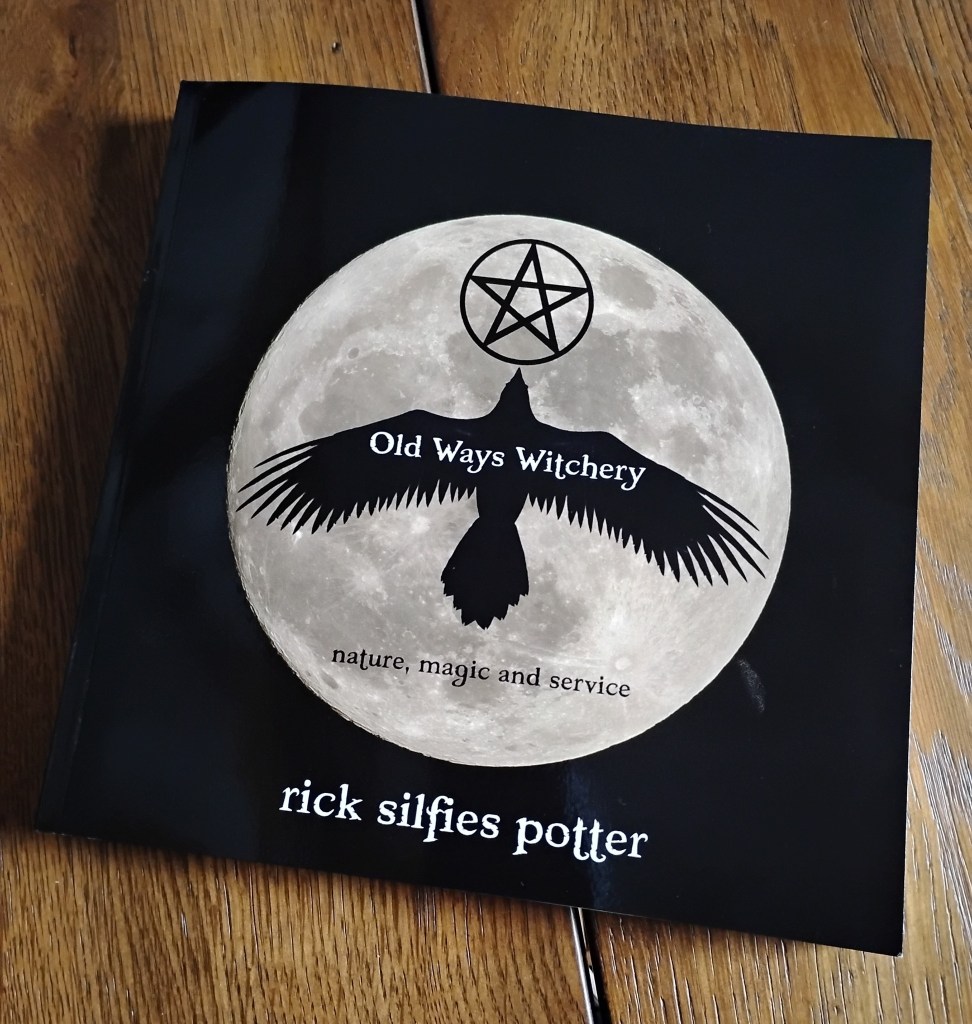
My latest book, “Old Ways Witchery: Nature, Magic and Service” contains the twelve monthly lessons that I have shared with private students for over a decade. Each lesson focuses on specific plants, stones and deity figures from the Irish, Scottish and Welsh pantheons. Also in each lesson you will find information on European folk magic, divination, spellcasting, druid philosophy and many other topics. The entire book contains wisdom I have gained from my own studies and meditations, and from teachers that I have had the privilege of meeting and studying with personally. Each lesson takes one month to complete, and includes homework and practical application. This book contains my own practice, and is presented exactly the way I practice it. I call it a “tradition”, as it is something I have passed on to my own students, but anyone can incorporate these lessons into their own practice. Each lesson is devoted to one month, beginning with March. My private lessons usually begin at this time, but those who have the book can begin at any time. It did take me quite awhile to format all of my lessons into one book. Time was scarce, as I still work a full-time job in the city and commute every day to the mountains where I live. Weekends are my writing times, since during the week I’m much too exhausted.
My definition of Old Ways includes beliefs and practices that pre-date modern magical systems such as Wicca. I present a blend of Witchcraft, Celtic Paganism, Druid Philosophy, Folk Magic, Occult Wisdom and other esoteric knowledge that has been passed down through the centuries. This may differ from other Old Ways traditions that have their own practices and rituals. Although the Old Ways themselves are not rooted in any one culture, they can have cultural elements. For instance, there are Italian Old Ways, Greek Old Ways and Celtic Old Ways. All of these pre-date modern magical practices. My practice happens to focus on the Celtic pantheon, with it’s associated imagery and lore.
Old Ways Witchery: Nature, Magic and Service is presented as a structured, monthly practice in twelve lessons. Get your copy now at this link.
Unlike many witchcraft traditions that call the Four Directions (North, East, South, West) when casting the circle, in our practice of Old Ways Witchery, it is the Three Realms (Land, Sea and Sky) that are called forth. Each of the three realms are associated with an animal that lends it’s energy to that realm for the duration of the circle. Land is associated with the Stag, Sea is linked to the Salmon, and Sky is associated with the Owl. The realms of land, sea and sky, along with these animals, are frequently represented throughout Celtic lore. In this article, we will explore each of these and why they are important to our practice.
Land and the Stag
The realm of land is the realm of the material world. It is the realm of living and working. It is the realm of finances and food, of existing on the earthly plane. It is the realm of flowers and plants, of trees, mountains and forests. The land is represented by the stag. When we cast the circle, we stand facing the north and say, “We call upon the Spirit of the Great Stag who dwells in the forest, and we ask for the blessing of the Land”. The Great Stag is the guardian of the forest and all that dwell within it. Associated with the Celtic antlered god Cernunnos, he is pictured as a man with large antlers on his head as he roams among the trees. The antlers of the stag are compared to tree branches. When the moon is viewed between the antlers of a stag, it is a blending of active and receptive energies. Celtic lore tells us that the stag is a creature that walks between the worlds.
Sea and the Salmon
The realm of sea is the realm of emotion. It is the realm of adaptability and change. It can be calm one moment and rough the next. It can be boiling hot or freezing cold. It can both sustain life, or drown it. It is a powerful force, difficult to control. The sea is represented by the salmon. When we cast the circle, we stand facing the west and say, “We call upon the Salmon of Wisdom who dwells in the sacred waters, and we ask for the blessing of the Sea”. Salmon live in both freshwater and saltwater. They swim upstream, following a familiar scent that leads them back to the location of their birth, where they reproduce. For this reason, they are associated with persistence, strength and determination.In an ancient Welsh tale, the salmon assists Arthur in finding the lost child Mabon and returning him to his mother.
Sky and the Owl
The realm of sky is the realm of thought. It is the realm of intuition and psychic ability. It is the realm of creativity and wisdom. The sky is represented by the owl. The owl has long been associated with witches and witchcraft. Because it is a nocturnal animal with keen eyesight, magical lore tell us it has the ability to “see the unseen”. It can observe without being observed and it’s flight is completely silent. The owl is primarily a creature of the night, and can be called upon to reveal that which is hidden or kept secret. There are over 200 species of owls, and they can be found on every continent except Antarctica. A Gaelic name for owl is “Cailleach-oidhche”, meaning “crone of the night”. When we cast the circle, we stand facing the east and say, “We call upon the Spirit of the Owl who dwells in the hidden realms and sees the unseen, and we ask for the blessing of the Sky”.
In our practice of Old Ways Witchery, the Stag, the Salmon and the Owl are called upon at the beginning and end of every ritual, to evoke and give thanks for the blessings of the Land, the Sea and the Sky. These are perfectly illustrated in the Celtic triskele symbol.
Some may notice the absence of fire in these evocations, and there is a reason. We carry the fire within us. We bring our own passion, our own life force, our own inner flame to the ritual. There is an old Welsh word, NWYFRE, that means “Life Force Energy”, and this energy is represented by the Dragon. This ‘dragon energy’ exists within all of us.
Beltane or Beltaine is the anglicised spelling of Old Irish Beltain, and Scottish Gaelic Bealltainn, the Gaelic name for either the month of May or the festival that takes place on May 1st. Some wait until astrological Beltane, at the midpoint between the Spring Equinox and Summer Solstice. In 2024, this happens to be on May 4th. In Irish Gaelic, the month of May is known as Mí Bhealtaine or Bealtaine, and the festival as Lá Bealtaine. In Gaelic folkore, the village’s cattle were driven between two fires to purify them and bring luck (Eadar dàtheine Bhealltainn in Scottish Gaelic, ‘Between two fires of Beltane’). In Scotland, boughs of Juniper were sometimes thrown on the fires to add an additional element of purification and blessing to the smoke. People would also pass between the two fires to purify themselves. In Wiccan traditions, Beltane is the celebration of the courtship of the Goddess and the God. The Earth is beginning to flourish. The trees are growing greener, and life has returned. It is a very sensual holiday, a time of joining together, as the Goddess and God consummate their love for one another. The dance around the Maypole is symbolic of this union. The Maypole (a phallic symbol) is erected with colorful ribbons attached. As each person dances around the Maypole holding the end of a ribbon, the last couple to reach the end is crowned the May Queen and May King. It is a dance that symbolizes the weaving of human life with the life of Nature. The Maypole is also a symbol of vegetation returning to the land as Summer approaches. It is a perfect time for spellwork that involves bringing a project to completion. Beltane is a highly creative and erotic holiday. It is a time to create something new, form new unions, and put away the past. The lighting of bonfires is a traditional practice on Beltane, to ensure the fertility of our households and in our own lives. It was common on Beltane for couples to run off into the woods to do what comes naturally. This is also a time when the veil between the worlds is thin again(the other time is at Samhain), and communication with loved ones who have passed on is possible. The doors to the Faery Realm have opened, and they frolic among us. Beltane is one of the four Celtic festivals. The others are Samhain, Imbolc and Lughnasadh.
There are very few mentions of the herbalist goddess Airmed in Celtic lore. We know from the stories that she is a healer from the Tuatha de Danann, one of the groups of Gods and Goddesses of Pagan Ireland. She comes from a family of healers. Together with her father Dian Cecht (a god of medicine) and her brother Miach ( a god of surgery), she tended a sacred spring that brought the dead back to life. A 15th century Celtic manuscript (Dindsenchas) tell us:
“The slain and mortally wounded were cast into a healing well over which Dian Cecht, his son Miach and his daughter Airmed sang incantations, and all were restored to full vigor.”
Dian Cécht was the healer for the Tuatha De Danann. He made King Nuada a silver arm which could move and function as a normal arm. Later, Dian Cecht’s son, Miach, replaced the silver arm with an arm of flesh and blood, and Dian Cecht killed him out of envy. Miach’s sister, Airmed, mourned over her brother’s grave. As her tears fell, all the healing herbs of the world grew from the grave. Airmed arranged and catalogued them, but then Dian Cécht again reacted with anger and jealousy and scattered the herbs, destroying his daughter’s work as well as his son’s. For this reason, it is said that no human knows the healing properties of all the herbs. Airmid still remembers the powers of the herbs, and can teach us their secrets.
Through her, we may learn to use and appreciate the sacred power of plants. Her medicinal herbs were powerful, offering cures for every part of the body. Airmid’s herbs continue to have power, whether in seed and root, bud and stem, or flower and leaf. Fresh or dried, the herbs still have effect. She works through nature’s cycles, and through the energy that connects the body’s joints and sinews. Through our work in ritual with Airmid, we can learn to harness the healing powers of herbs and plants, to bring healing to ourselves and those around us.
Looking Deeper with Dian Cecht and Airmid
AIRMID:
What is your current relationship with the plant world? Do you have a garden? What are your favorite plants? Prepare a space where you can begin planting the herbs and plants that we work with in Old Ways Witchery. Some of them, such as Blackthorn and Mandrake, may need to be obtained online. Call upon Airmid for guidance with planting and tending.
Begin a study of the medicinal qualities of various herbs and plants. Include in your studies the uses of herbal teas and flower essences.
Airmid is a compassionate healer. She encourages us to bring healing to others from a place of compassion and knowledge, rather than boastfulness or pride.
DIAN CECHT:
Lore surrounding Dian Cecht tells us that his symbol are two crossed branches of oak and mistletoe. These are items that can be used to evoke his presence.
His actions remind us not to compare our gifts with those of others. Let us put aside envy and jealousy, and seek to learn from those who have excelled in their craft.
Seek his strength after times of trial and struggle. He is a healer of those in battle.
Another interesting thing often mentioned in the old Celtic legends is the working of magic through singing. Various tales have mentioned how healing, joy and rest were bestowed upon others through song or the playing of an instrument. This type of singing seems to be intuitive and inspired, rather than a specific song with words. In the story of Dian Cecht, Airmid and Miach, we see how they incorporated the singing of incantations. It is a powerful thing to experience, intuitively singing while doing healing work. It doesn’t have to be lyrical, just sing as you feel guided, and sense the healing energies flowing from you to the recipient. If you have written a healing chant, practice setting it to music and singing it aloud when doing healing work for others. This is another magical skill that cannot be learned from a book or a physical teacher, one that must be developed and brought out from within, with the help of our spiritual guides and gods.
Of all the Celtic Gods, Lugh was one of the most beloved. He was the “Shining One”, according to some versions, a son of Mannanan MacLir, and skilled in all the arts. He was called Lugh Lamfada (“of the long arm”) and Samildanach (meaning “skilled in all the arts”). He was a beautiful child with golden hair like the sun. He is portrayed as handsome and youthful. Tailtiu was the Goddess of Sovereignty, the queen of the Fir Bolg and his foster mother. She lived on the Hill of Tara, where she taught Lugh, helping him to learn about history, poetry, music and everything he would need to learn to be a well-rounded and powerful leader. When Lugh became an adult, he tried to enter the court of King Nuada (NOOa-ha). Just as everyone was sitting down to feast. The gatekeeper challenged Lugh to tell his name and of his skill. For no one without a special art or skill may enter Tara. “I am a smith”, said Lugh. “We already have a smith”, said the gatekeeper. “Why would we need another?” “I am a warrior”, said Lugh. “We have no need of one”, laughed the gatekeeper, “Ogma is our champion”. “I am a harpist”, said Lugh. “We have a harpist”, said the gatekeeper, “and quite a good one at that”. “I am a hero” said Lugh, “renowned for skillfulness rather than mere strength”. “All of the gods are heroes”, the porter shook his head at Lughs persistence. “I am a poet and a tale-teller from the land of apples, rich in swans & yew trees” said Lugh. “Taliesin is the greatest poet in Ireland”, said the gatekeeper, “Why would we need you?” “I am a cup-bearer”, said Lugh. “We already have nine of them”, said the porter. “I am a worker in bronze”, said Lugh.
“We have no need of you. We already have a worker in bronze”, said the gatekeeper. “I am an historian, a doctor, and a magician”, Lugh told him. The gatekeeper responded, “We already have men skilled in all these things. I dont see why we would need your services”. “But do you have anyone who is master of all of these crafts at once?” Lugh asked. The gatekeeper had to admit that they did not, and invited him in. Lugh entered and sat down upon a chair kept for the wisest man. The champion, Ogma was showing off his strength by pushing around a large flagstone. The stone, as huge as it was, was only a portion broken from a still greater rock. Lugh picked it up in his hands and put it back in its place. The king asked him to play the harp. Lugh played the sleep-tune and the king and all his court fell asleep until the same time the next day. Next Lugh played a lamenting tune and they all wept, and then he played a song which brought them joy. When the king saw all these talents he gave the throne to Lugh for thirteen days. Lugh became the leader of the Tuatha De Danann. Lugh’s foster mother Tailtiu died of exhaustion after working hard to clear the lands of Ireland for farming. Lugh was so fond of her that he held a festival in her memory. People would gather around bonfires, sharing stories and food. They would compete in contests of skill and strength. Lugh invented ball games and horse races for all to play. It was said that as long as these traditions continued there would be corn and milk in every house, peace and fine weather for the feast. Tailtiu became the Goddess of the Harvest, like Ceres to the Romans, and Corn Mother to Native Americans. She looked on as her children played and feasted. The festival of Lughnasadh is still celebrated in memory of Lugh the Sun King, and his beloved Foster Mother and Teacher; Tailtiu.
Lughnasadh (Festival of Lugh) is the first of three harvest festivals, traditionally celebrated on August 1st. In Irish Gaelic, and a slightly different spelling, Lunasa is the word for August. In the Christianized version, it is called Lammas (meaning Loaf-Mass or the Feast of Bread, at which time the first loaves of the season were blessed by the church). The hot days of August are now upon us, much of the earth is dry and parched, but we still know that the bright reds and yellows of the harvest season are just around the corner. Apples are beginning to ripen in the trees, our summer vegetables have been picked, corn is tall and green, waiting for us to come gather the bounty of the crop fields. Now is the time to begin enjoying the fruits of our labors, both on the table and in our lives. We honor this holiday to celebrate the first harvest, and the Celtic God Lugh, the sacrificed King of the Grain. Grain has held a place of importance in civilization back nearly to the beginning of time. Grain became associated with the cycle of death and rebirth. In early Ireland, it was a bad idea to harvest your grain any time before Lughnasadh — it meant that the previous year’s harvest had run out early, and that was a serious failing in agricultural communities. However, on August 1, the first sheafs of grain were cut by the farmer, and by nightfall his wife had made the first loaves of bread of the season.
Lughnasadh is a day of honoring Lugh, the Celtic craftsman god. He is a god of many skills, and was honored in various aspects by societies both in the British Isles and in Europe. Lughnasadh is still celebrated in many parts of the world today, and his influence appears in the names of several European towns. In our modern world, it’s often easy to forget the trials and tribulations our ancestors had to endure. For us, if we need a loaf of bread, we simply drive over to the local grocery store and buy a few bags of prepackaged bread. If we run out, it’s no big deal, we just go and get more. When our ancestors lived, hundreds and thousands of years ago, the harvesting and processing of grain was crucial. We honor our ancestors and the hard work they had to do in order to survive. This is a good time to give thanks for the abundance we have in our lives, and to be grateful for the food on our tables. As we enjoy nature’s abundance, what can we give in return? Lughnasadh is a time of transformation, of rebirth and new beginnings. Because of its association with Lugh, The Many-Skilled One, Lughnasadh is also a time to celebrate talents, skills and craftsmanship. What are your talents and gifts? How can you share those talents and gifts with others? Now is the time of year to work on developing your own talents. Learn a new craft, or get better at an old one. Start a creative project, write a book, play a musical instrument, sing a song, dance, paint. Learn a new magical skill, such as the reading of runes or the making of candles. Whatever you choose to do, this is the right season for thankfulness and sharing.
I have encountered many pagans who have a practice that seems rather chaotic and random, with no rhyme or reason, and approach it with a sort of casual “whatever I feel like today” attitude. There is no discipline or consistency to their practice. Many become “Eclectic” witches, because they don’t want to be limited to one particular system or pantheon. This buffet-style paganism seems to work for some, but leaves others feeling their energies scattered and ungrounded.
My practice has remained largely unchanged for the last ten years, but it is still just as vibrant and alive as ever, because it is based on connection and relationship. While it is very structured, it still allows room for growth. I will share my practice with you, and give suggestions on how to develop your own. In the meantime, consider the following:
What deity figures, gods and goddesses do you feel the strongest connection with?
Which crystals and stones do you use most often?
What flowers, herbs and plants, if any, are the most important to your personal practice?
Consider your magical skills. Perhaps you’re a tarot reader or a Reiki practitioner. Would you like to develop these skills further?
Below is a brief outline of my yearly practice. You will see that even though it has organization and structure, there is room for growth and versatility. I have strong connections to the Celtic current and it’s magical systems, so this is what I work with exclusively. You may choose to work with others of your choice. I present this only as an example, so that you can use it as a template for your own personal practice.
January
Deity: Cu Chulainn
Plant: Valerian
Stone: Citrine
Weekly Divinations
Rituals: Full Moon and New Moon
Reading and Study
Meditation
February
Deity: Brigid
Plant: Hyssop
Stone: Rose Quartz
Weekly Divinations
Rituals: Imbolc, Full Moon/New Moon
Make Brigid’s Cross for altar
Reading and Study (Tending Brigid’s Flame by Lunaea Weatherstone)
Meditation
March
Deities: Cerridwen and Taliesin
Plant: Blackthorn
Stone: Green Aventurine
Weekly Divinations
Rituals: Spring Equinox, Full Moon/New Moon
Crafting and Consecrating a New Wand
Reading and Study (Mabinogion, Cerridwen by Kristoffer Hughes)
Meditation
April
Deities: Dian Cehct and Airmid
Plant: Mandrake
Stone: Moonstone
Weekly Divinations
Rituals: Full Moon/New Moon
Reading and Study
Meditation
May
Deity: Cernunnos/Herne/Green Man
Plant: Sage
Stone: Clear Quartz
Weekly Divinations
Rituals: Beltane, Full Moon/New Moon
Make a new batch of Personal Oil
Reading and Study (Three Cauldrons of Poesy)
Meditation
June
Deity: Manaanan Mac Lir
Plant: Lavender
Stone: Amethyst
Weekly Divinations
Rituals: Summer Solstice, Full Moon/New Moon
Visit to Peace Valley Lavender Farm
Make a new Crane Bag
Astral Projection/Psychic Travel Exercise
Reading and Study
Meditation
July
Deity: Rhiannon
Plant: Marigold
Stone: Lapis Lazuli
Weekly Divinations
Rituals: Full Moon/New Moon
Reading and Study (The Song of Amergin)
Meditation
August
Deity: Lugh
Plant: Yarrow
Stone: Tree Agate
Weekly Divinations
Rituals: Lughnasadh, Full Moon/New Moon
Re-dedicate skills and abilities to Cerridwen and Community
Craft new Protection Amulets and Talismans
Dragon Magic
Reading and Study
Meditation
September
Deity: Mabon
Plant: Cinquefoil
Stone: Selenite
Weekly Divinations
Rituals: Autumn Equinox, Full Moon/New Moon
Reading and Study (Mabon story from The Mabinogion)
Meditation
October
Deity: Morrigan
Plant: Wormwood
Stone: Black Obsidian
Weekly Divinations
Rituals: Samhain, Full Moon/New Moon
Craft a new Ancestor Bottle
Craft a new batch of Ancestor Incense
Reading and Study (Celtic Lore and Spellcraft of the Dark Goddess, by Stephanie Woodfield)
Meditation
November
Deity: Dagda
Plant: Mugwort
Stone: Hematite
Weekly Divinations
Rituals: Full Moon/New Moon
Reading and Study
Meditations
December
Deity: Cailleach
Plant: Mistletoe
Stone: Snowflake Obsidian
Weekly Divinations
Rituals: Winter Solstice, Full Moon/New Moon
Craft a new Silver Branch
Reading and Study
Meditations
This is not an exhaustive list of everything I do each month, there are other more specific things I could have added, but I did not want to make it too confusing. As you can see, there is room to be flexible on various things, such as study material or forms of divination. I typically use tarot, oracles, pendulum and crystal ball. I practice various forms of meditation, including chant and creative visualization. There are certain things I do at specific times of the year, such as wand making in the spring and protection talismans in the summer. Add practices that are meaningful to you in your own yearly devotionals.
By working with the same deities, plants and stones on a consistent basis, you develop a stronger connection to them. You can use this same format to choose which of these you will focus on each month. Many people have one specific deity they are closest to, and for me that is Cerridwen. I acknowledge her in all of my rituals and her statue is on my altar year round, but there are other deities I draw near to each month as well. It is my hope that sharing my yearly practice will help others develop their own. You will find that a structured practice such as this will be more meaningful than one that is scattered and disorganized. After all, you will be working with the deities, plants and stones that you have the strongest connection to, and learning more about them each month. Discipline and consistency are key elements to developing strong relationships with our magical allies.
Before we explore various aspects of Celtic magic, it is important to understand what is meant by Celtic. The term Celtic refers to a cultural tribal group who moved into Northern Europe, the British Isles and Ireland. They are identified by their use of art, language, symbolism and mythology. There are two strands of Celtic culture, each recognized by it’s language. Q Celtic refers to the Gaelic languages: Scots Gaelic, Irish Gaelic and Manx (spoken on the Isle of Man). P Celtic refers to the Brythonic languages: Breton, Cornish and Welsh.
One does not have to be descended from a Celtic bloodline to practice Celtic magic. Anyone who feels a connection to the Celtic gods and goddesses are invited to draw near to them. The Celtic magical tradition is focused more on culture and mysticism rather than bloodline. Anyone can practice Celtic magic, despite what the self-appointed gatekeepers say.
While most magical systems acknowledge the four elements of Earth, Air, Fire and Water, in Celtic magic the emphasis is placed on Land, Sea and Sky. It may appear the fire element is absent, however, the fire exists within the practitioner. Celtic pagans draw fiery energy from within themselves and into their enchantments. Another aspect of fire being within is the concept of Nwyfre. This is a Welsh word that means “life force”, and this life force exists in everything. Nwyfre has been linked to the Dragon, another source of fire. Fire transforms, or is transformed by the other elements.
Fire burns the Land (Earth).
Fire is quenched by the Sea (Water).
Fire is fueled by the Sky (Air).
Those who practice Celtic magic celebrate the same holidays as other pagans, as most of these holidays are of Celtic origin. We know that the Celts only recognized a few of these, such as Beltane, Lughnasadh and Samhain, however, modern Celtic pagans celebrate eight holidays in total.
These holidays include IMBOLC, occuring on February 1st or 2nd which honors the Celtic Saint/Goddess Brigid. The SPRING EQUINOX occurs around March 21st and celebrates the newness of life and the reawakening Earth. BELTANE takes place on May 1st, a very erotic and sexually charged holiday. The SUMMER SOLSTICE occurs around June 21st. LUGHNASADH takes place on August 1st and is the first harvest festival of the year, named after the Celtic god Lugh. Around September 21st is the AUTUMN EQUINOX or MABON, the second harvest festival named after the Welsh figure Mabon. SAMHAIN, the third and final harvest, is celebrated on October 31st, when departed loved ones are honored and believed to be closer than ever. The WINTER SOLSTICE, what many pagans refer to as YULE, takes place around December 21st.
While we know very little about spiritual practices of the ancient Celts, modern scholars believe clues can be found in the lore and legends. It is true that the Druids, the spiritual elders of the Celtic peoples, did not write anything down. However, there are at least fourteen classical authors who lived during the time of the druids and documented some of their practices. The Celtic tales are believed to contain many hidden mystical lessons. These lessons are revealed only through study and meditation, and by placing ourselves within the stories. To be understood, they must be experienced. For those who wish to practice Celtic magic, a working knowledge of the mythology is a priority.
The primary magical tools of the Celtic pagan are the cauldron and the wand. Both of these feature prominently throughout Celtic lore. The cauldron is a container of energy and also acts as a vessel of communication. When we place our hands on the cauldron, we tap into centuries of magic and make a connection to the divine mind of the ancient gods and goddesses of Ireland, Scotland and Wales. The most important cauldron is the one that belongs to Cerridwen, a Welsh goddess of Transformation and Initiation. From her cauldron is the source of Awen, a Welsh word that means “Divine, Poetic Inspiration”. Cerridwen is the original cauldron-stirring, potion-brewing witch. She is the spiritual mother of the “inspired ones”, sometimes referred to as the Awenyddion.
Other gods and goddesses of Celtic lore and legend include:
Brigid: Goddess of Healing, Poetry and Smithcraft. She is both Goddess and Saint. Those who follow her are called Flamekeepers, keeping alive an old tradition of the Brigidine Sisters tending the holy flame at the monastery of Brigid at Kildare. Her sacred day is Imbolc.
Lugh: The Celtic Sun god. He is called The Many-Skilled One, skilled in all the arts. An accomplished warrior, athlete, harpist and poet. The holiday Lughnasadh (“Games of Lugh”) is named after him.
The Morrigan: Goddess of War, Magic and Death. She is a triple-goddess also known by the names of Badb, Macha and Anu. Her sacred animals are the Crow and Raven.
Manaanan Mac Lir: Sea God of the Tuatha De Danaan. He possesses a horse than can gallop across the waves, a ship that needs no oars or sails to travel, and a sword that can fill men’s hearts with fear. The waves of the sea are called “the horses of Manaanan”.
Rhiannon: Welsh horse goddess of magic, forgiveness and wisdom. She is also associated with birds. The “Birds of Rhiannon” are three birds who can wake the dead and lull the living to sleep.
Cernunnos: Stag god of the forest, primal, masculine ruler of animals and all green things that grow. He is often portrayed as a man with antlers.
In some versions of the tale of Manaanan Mac Lir, his wife Aoife was turned into a crane. When she died, Manannan made a bag from her skin that would hold magical items. Many Celtic pagans make crane bags in which they place items of magical or spiritual significance. It can be made of leather, cotton, linen, wool or any other fabric. It can be any color, and may be decorated with Celtic symbols or imagery. The Crane Bag is similar to a Mojo Bag or Medicine Bag, and what you place in it is entirely up to you.
Such items may include:
• Crystals and Stones
• Seashells
• Plants, leaves, twigs, roots or bark
• Herbs, plants or flowers
• Seeds
• Feathers
• Fur, nails, bones, claws or other animal parts
• Animal, plant or spirit guide figures
• Ogham, runes or other items with magical symbols
• Any other items with a spiritual purpose
When practicing divination, many Celtic pagans look to the wisdom of the Ogham. The Ogham began as an ancient British and Irish alphabet, consisting of twenty characters formed by parallel strokes on either side of, or across a continuous line. It evolved into a system of divination, largely due to the work of Robert Graves in his book The White Goddess. Each ogham symbol is associated with a specific tree and a divinatory meaning.
Ogham staves
A 15th century Irish manuscript known as the “Cauldrons of Poesy” tells us that the human body contains three cauldrons. These cauldrons are located in the head, heart and belly of each person. The cauldron in the head is the Cauldron of Wisdom, ruling spiritual health. The cauldron in the heart is the Cauldron of Motion, ruling Psychic Health. The cauldron in the belly is the Cauldron of Warming, ruling physical health. These three cauldrons are similar to chakras, as each one represents various aspects of life. They are used in meditation, visualizing each cauldron in the upright position.
Symbols used in Celtic magic include the triquetra and the triskele. The triquetra is a Celtic knot symbol consisting of a triple knot with with a circle in the middle. The triskele is a triple spiral that appears to be in motion, as if it is spinning. Both of these symbols represent the Land, the Sea and the Sky. They can be carved onto candles or drawn on parchment paper when casting spells. Objects with these symbols can be placed on your altar. Other imagery can be used, such as pictures of Stonehenge, Brigid’s Cross or figures of animals that appear in Celtic lore.
There are many facets of Celtic magic, and this article only addresses a few of them. The Celtic tradition is rich with symbolism and mystical lore. Those who hear the whispers of the stone circles and the misty moors are invited to draw close to the ancient gods of Ireland, Scotland and Wales.


 Rick S. Potter