The Witch’s Book of Shadows

The ‘Book of Shadows’ is shrouded in mystery and mysticism. Nearly every Witch has one, and while many may look similar on the outside, the contents therein are unique and individual to the Witch who owns it. Some say the Book of Shadows is a product of modern Wicca, however there are mentions of handwritten books kept by Witches as far back as the 17th century. There is also some confusion as to the difference between a Book of Shadows and a Grimoire. Many use the two words interchangeably, but there is a slight difference.

A Grimoire is a book (or portion thereof) that contains only spells and rituals. Many Witches have a Grimoire contained within their Book of Shadows. For most modern Witches, when we speak of a Book of Shadows, it is usually assumed that it contains a Grimoire. In my own Book of Shadows, I do have spells and rituals recorded, but they are not kept in a special section labeled “Grimoire”. They are interspersed throughout the book, with other information. There is no hard and fast rule about where to put things, although I prefer to record the herbs and plants all together at the end of the book, which makes them easier to find.

A Book of Shadows may contain a Grimoire, but it can also have other information. Herbs, correspondences, magical studies, meditations, drawings, symbols, lore and legends, personal observations, divination tips or any other info that the Witch has found personally useful in their own practice can be documented in a Book of Shadows.

So where does one find a Book of Shadows? Some simply use a special journal or a notebook, while others have large, elaborate tri-fold books that have 1,000 pages and weigh a ton. There are a few websites where you can purchase handmade Books of Shadows, but they are priced in the hundreds of dollars and take months to produce. If you are willing to invest the money and time, go for it. Or, you can use something a bit smaller, less expensive and more practical. It’s really up to you what you want to use, but I will offer a few suggestions. You may go through several, as I did, before you find the one you really like.

The magical journals of Old World witches were hand-written on parchment paper, using special inks and writing instruments, such as a feather quill. Dragon’s Blood Ink or India Ink are popular choices, as they take longer to break down. On the other hand, if something else works better for you, (or is more affordable), then use it. Some hardcore traditionalists would cringe at the thought of using colored pencils, stencils or rub-ons in their Book of Shadows, but I use them frequently.

Suggestions:

  • Look for something that fits your personality. Many seem to want something they have seen in movies or on TV, such as the Charmed Book of Shadows. Don’t fall into the pop culture trap. Find something that represents you.
  • Simple is often best. Instead of going for a mass-produced Book of Shadows covered with symbols or drawings, find something with a blank cover that you can personalize and decorate yourself. I prefer to leave my cover unadorned.
  • Don’t get something too small. Journals and notebooks are great, but eventually they will be full and you’ll have to start another one. I recommend looking at artist sketchbooks in hardcover. You can find them in larger sizes with 200+ pages and they are made specifically for those who paint or draw. There are also some gorgeous leather-bound books of parchment paper, which is what I use. Check your local art stores or look online to get a better variety. Consider your Book of Shadows a sacred object. The contents within are for your eyes only, hidden from public view and away from prying eyes. When not in use, keep it wrapped in a natural fiber.

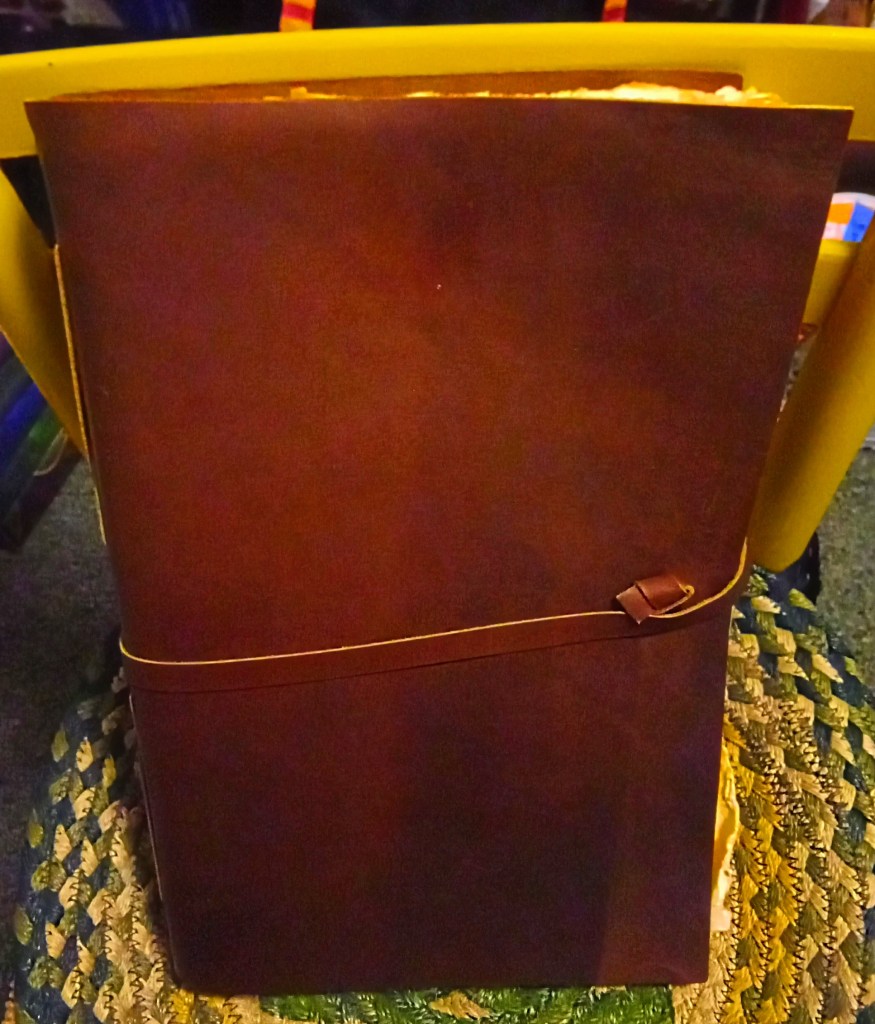
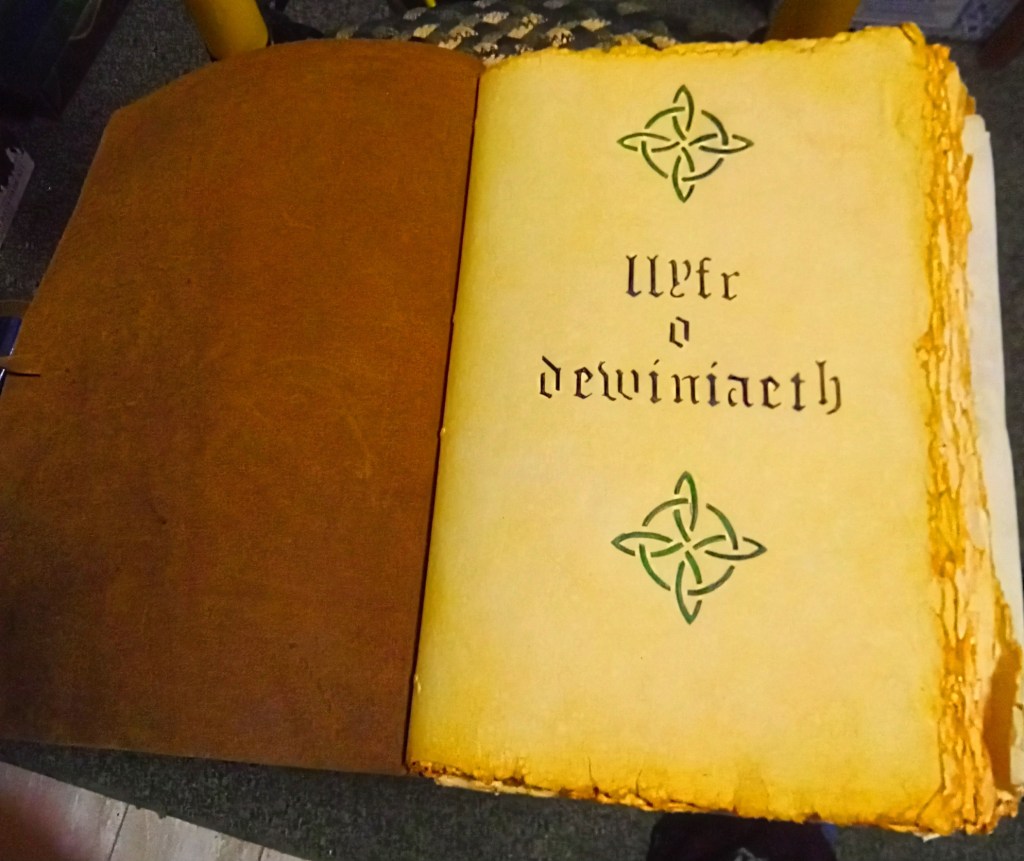
My own Book of Shadows, which I have named Llyfr o Dewiniaeth (Welsh for ‘Book of Magic’) is a large leather-bound book of parchment pages that have been given an antique appearance. I found this on Amazon, of all places. The pages are quite thick and suitable for writing, drawing or even painting on. It is a rare thing for me to share photos of my sacred book of magic, but here you only get to see the first page with it’s name. This book is one of my most prized possessions.

I want to emphasize again about not getting something too small. It is kind of a drag transferring everything from a smaller book into a larger one, and is very time-consuming. The larger ones are more expensive, but are well worth it in the long run. In my own book, I document the spells, rituals and magical information that I use most often, including information from books and teachers that have been most meaningful in my life and personal path. Do not just put random information in your book, but only that which has the most meaning for you and that which you will use on a regular basis. Your Book of Shadows, or whatever you choose to call it, is meant to be personal and an extension of your magical identity.

When Spells Don’t Work

Magic can be tricky, and there are some things that can make your spells ineffective. Take note of the following list when planning your magical workings.

  • Energy Failure: If energy is not raised properly or is not allowed to reach it’s peak, it is likely your spell will not manifest. Practice different forms of energy raising techniques, such as chanting, dancing or burning parchment with a written intention to discover which works best for you.
  • Doubt: If you do not believe in what you’re doing and you really don’t think it will work, then chances are it will not.
  • Unclear Intention: Know exactly what you want. Be specific. If you are indecisive or unclear, nothing will manifest for you. If you are not specific enough, you may get what you want, but with unpleasant strings attached.
  • Don’t Talk About It: Telling your friends or posting on social media about the spell you cast last night is a sure way of bringing that energy back to you and disabling your spell. Remain silent about your spellcasting. Skeptical friends or outsiders who have negative opinions about spells and magic can bring their harmful energy into the process. Your best bet is to be silent about your magical workings until they have manifested into physical reality.
  • Weak Will: If your will is not strong enough or if you’re really not sure it is what you want, this can also sabotage your spell. Be commanding and know that it is yours.
  • Lack of Follow-Up: If you cast a job spell but you don’t submit any resumes or go on interviews, you can’t expect to get that job. Follow up is important.
  • Scattered Correspondences: If the symbols and energies you use in your spell do not have any association to the outcome, there is a good chance your spell will not manifest. Like attracts like.
  • Mercury Retrograde: It is a matter of debate whether or not it is a good idea to do spellwork while Mercury is in retrograde. A good rule of thumb is, if it bothers you, then don’t do it. If you feel confident enough to cast your spell, and it cannot wait until Mercury goes direct, then cast it. Some practitioners include in their spell “I neutralize the power of Mercury in Retrograde“.
  • Lack of Full Attention: If you are distracted or in a hurry while casting your spell, then it is not likely to have the effects you want. Wait until you can be undisturbed and give the spell all of your attention and focus.
  • Violation of Free Will: This is a rather grey area, as these kinds of spells do work, but with repercussions. Magic that is used to control others or make them do something they would not otherwise do is a dangerous practice. The power of suggestion is real, however, the only way another person can use magic to violate another’s free will is if there is already a weakness or foothold in the area of suggestion. It is very important that those who work with magic constantly examine themselves, We must discipline our minds and work to take control of our fears, anxieties and passions. It is not an easy task.
  • Moon Phases and Planetary Energies: These can work against you if your spell is cast during unfavorable times. Be aware of current moon phases and planetary hours to get more power behind your spells.
  • True Will and the Plan of the Universe: There are times when we may cast a spell that is not for our highest good, and does not fit within the plan of the universe. There may in fact be something even better for us on the horizon, and a particular spell may not be aligned with our true will. It is important to include in our spells an intention of “for the highest good” and an outcome that is “perfect and correct”. It is equally important to focus on the outcome of your spell and not on how it manifests.

The casting of spells is an art and a science. There are many factors that come into play. This is not an exhaustive list of things that can wreck your spell, but they are some important ones. Plan your spells carefully.

Benefits of a Structured Practice

I have encountered many pagans who have a practice that seems rather chaotic and random, with no rhyme or reason, and approach it with a sort of casual “whatever I feel like today” attitude. There is no discipline or consistency to their practice. Many become “Eclectic” witches, because they don’t want to be limited to one particular system or pantheon. This buffet-style paganism seems to work for some, but leaves others feeling their energies scattered and ungrounded.

My practice has remained largely unchanged for the last ten years, but it is still just as vibrant and alive as ever, because it is based on connection and relationship. While it is very structured, it still allows room for growth. I will share my practice with you, and give suggestions on how to develop your own. In the meantime, consider the following:

  • What deity figures, gods and goddesses do you feel the strongest connection with?
  • Which crystals and stones do you use most often?
  • What flowers, herbs and plants, if any, are the most important to your personal practice?
  • Consider your magical skills. Perhaps you’re a tarot reader or a Reiki practitioner. Would you like to develop these skills further?

Below is a brief outline of my yearly practice. You will see that even though it has organization and structure, there is room for growth and versatility. I have strong connections to the Celtic current and it’s magical systems, so this is what I work with exclusively. You may choose to work with others of your choice. I present this only as an example, so that you can use it as a template for your own personal practice.

January

  • Deity: Cu Chulainn
  • Plant: Valerian
  • Stone: Citrine
  • Weekly Divinations
  • Rituals: Full Moon and New Moon
  • Reading and Study
  • Meditation

February

  • Deity: Brigid
  • Plant: Hyssop
  • Stone: Rose Quartz
  • Weekly Divinations
  • Rituals: Imbolc, Full Moon/New Moon
  • Make Brigid’s Cross for altar
  • Reading and Study (Tending Brigid’s Flame by Lunaea Weatherstone)
  • Meditation

March

  • Deities: Cerridwen and Taliesin
  • Plant: Blackthorn
  • Stone: Green Aventurine
  • Weekly Divinations
  • Rituals: Spring Equinox, Full Moon/New Moon
  • Crafting and Consecrating a New Wand
  • Reading and Study (Mabinogion, Cerridwen by Kristoffer Hughes)
  • Meditation

April

  • Deities: Dian Cehct and Airmid
  • Plant: Mandrake
  • Stone: Moonstone
  • Weekly Divinations
  • Rituals: Full Moon/New Moon
  • Reading and Study
  • Meditation

May

  • Deity: Cernunnos/Herne/Green Man
  • Plant: Sage
  • Stone: Clear Quartz
  • Weekly Divinations
  • Rituals: Beltane, Full Moon/New Moon
  • Make a new batch of Personal Oil
  • Reading and Study (Three Cauldrons of Poesy)
  • Meditation

June

  • Deity: Manaanan Mac Lir
  • Plant: Lavender
  • Stone: Amethyst
  • Weekly Divinations
  • Rituals: Summer Solstice, Full Moon/New Moon
  • Visit to Peace Valley Lavender Farm
  • Make a new Crane Bag
  • Astral Projection/Psychic Travel Exercise
  • Reading and Study
  • Meditation

July

  • Deity: Rhiannon
  • Plant: Marigold
  • Stone: Lapis Lazuli
  • Weekly Divinations
  • Rituals: Full Moon/New Moon
  • Reading and Study (The Song of Amergin)
  • Meditation

August

  • Deity: Lugh
  • Plant: Yarrow
  • Stone: Tree Agate
  • Weekly Divinations
  • Rituals: Lughnasadh, Full Moon/New Moon
  • Re-dedicate skills and abilities to Cerridwen and Community
  • Craft new Protection Amulets and Talismans
  • Dragon Magic
  • Reading and Study
  • Meditation

September

  • Deity: Mabon
  • Plant: Cinquefoil
  • Stone: Selenite
  • Weekly Divinations
  • Rituals: Autumn Equinox, Full Moon/New Moon
  • Reading and Study (Mabon story from The Mabinogion)
  • Meditation

October

  • Deity: Morrigan
  • Plant: Wormwood
  • Stone: Black Obsidian
  • Weekly Divinations
  • Rituals: Samhain, Full Moon/New Moon
  • Craft a new Ancestor Bottle
  • Craft a new batch of Ancestor Incense
  • Reading and Study (Celtic Lore and Spellcraft of the Dark Goddess, by Stephanie Woodfield)
  • Meditation

November

  • Deity: Dagda
  • Plant: Mugwort
  • Stone: Hematite
  • Weekly Divinations
  • Rituals: Full Moon/New Moon
  • Reading and Study
  • Meditations

December

  • Deity: Cailleach
  • Plant: Mistletoe
  • Stone: Snowflake Obsidian
  • Weekly Divinations
  • Rituals: Winter Solstice, Full Moon/New Moon
  • Craft a new Silver Branch
  • Reading and Study
  • Meditations

This is not an exhaustive list of everything I do each month, there are other more specific things I could have added, but I did not want to make it too confusing. As you can see, there is room to be flexible on various things, such as study material or forms of divination. I typically use tarot, oracles, pendulum and crystal ball. I practice various forms of meditation, including chant and creative visualization. There are certain things I do at specific times of the year, such as wand making in the spring and protection talismans in the summer. Add practices that are meaningful to you in your own yearly devotionals.

By working with the same deities, plants and stones on a consistent basis, you develop a stronger connection to them. You can use this same format to choose which of these you will focus on each month. Many people have one specific deity they are closest to, and for me that is Cerridwen. I acknowledge her in all of my rituals and her statue is on my altar year round, but there are other deities I draw near to each month as well. It is my hope that sharing my yearly practice will help others develop their own. You will find that a structured practice such as this will be more meaningful than one that is scattered and disorganized. After all, you will be working with the deities, plants and stones that you have the strongest connection to, and learning more about them each month. Discipline and consistency are key elements to developing strong relationships with our magical allies.

The Lost Art of Tree Gazing

Divination by leaves and branches of trees, called Dendromancy, relies heavily on intuition and the inner voice. By observing the whispers of leaves, and the swaying of branches in the wind, the trees offer their wisdom for our personal growth. When tree gazing, it is best to approach them with open-ended questions rather than seeking a “yes-or-no” answer. Scientific studies suggest that trees communicate with each other through root systems and fungi under the earth, and through the air using pheromones and other chemicals. With a world-wide network of trees, many that are thousands of years old, they are believed to have developed a language of their own. They can also communicate with humans who have learned to listen.

Whenever a witch places their hands on a tree with the intention of healing and communication, the tree responds accordingly. An old word for witch is Pharmaceute, where we get the word pharmacist. This word denotes the witch as someone knowledgeable in the healing properties of flowers, plants and trees. The trees will nearly always recognize a pharmaceute, for they know you mean them no harm and your intentions are for the highest good. When tree gazing during the light half of the year (spring and summer), observe the sound and movements of the leaves and branches. During the dark half of the year, (fall and winter), observe the bare branches as they dance in the wind. You will find the energy feels different at different times of the year.

To begin tree gazing, you must first find the tree you wish to communicate with. You may have a favorite tree already, or you may wish to find a tree at a local park. Intuitively listen as you walk among the trees until you find one that “feels” friendly and receptive. Find a spot where can sit undisturbed near the tree for at least half an hour.

Next, close your eyes and take several deep breaths until you reach a meditative state. This will help make you more receptive to receive psychic information. Place your hands on the tree, and visualize white light coming out of your hands and into the tree. See the entire tree bathed in this healing white light. Project feelings of love and healing into it. Say to the tree, “Blessed tree, I come to seek your wisdom”, or “I seek your wisdom about...” then state your problem or issue. At this point you may keep your hands on the tree, or if you’re worried about getting looks from passers-by, sit as near to the tree as possible so you can observe it. Just as with most types of divination, the tree will impart information through impressions, images or feelings. Have a notepad and pen handy to jot down anything that comes to you. Do not stare at the tree, but let your gaze soften as you maintain an open, meditative state of mind. There are many things to take notice of as you observe the tree, such as:

  • What shapes or symbols do you see formed by the branches or leaves?
  • Are there any sounds coming from the tree? If the wind is blowing through the leaves, close your eyes and listen closely. What does the tree seem to be saying? Take note of your emotions. What are you feeling?
  • Is there any wildlife in or around the tree? Birds, insects and other animals all have their own unique wisdom. A bird building a nest could indicate that it’s time for you to start preparing for the future. Write down the animals see so you can explore their wisdom further at a later time.
  • Are there any plants growing on or near the tree? Mistletoe growing on an oak tree could suggest that you need to devote more time to spiritual practice. Write down all of the plants you see, and research their magical properties.
  • Is the tree near a body of water? If there are long branches extended over the water, take note of how it is reflected in the water below.

It is important not to be super-specific when tree gazing, as their wisdom seems to be more focused on personal growth and inner transformation, rather than “should I take this job” sort of questions. It may take some practice, but as the tree becomes more comfortable with you it will communicate more often. It is also good to know what kind of tree it is and any magical associations it may have. Consider the tree a friend, and it will respond in kind.

At the end of your tree gazing session, always leave it a gift. You can pour some spring water around it’s base, or leave some seeds, fertilizer or stones (Tree Agate, Clear Quarts or Aventurine are good choices). Thank the tree for sharing with you, and document your experience in a journal.

Your Personal Oil Blend

Essential oils have been used for thousands of years in healing, magic, religion and spirituality. Healing practitioners use them in Aromatherapy, Massage, Reiki and even Meditation. Witches use a variety of oils, crafted for specific purposes from healing to protection. There are many available on the market, and you can find oils already prepared in just about any Witchcraft store. You can find pre-made Healing Oil blends that are made from plants associated with Healing. There are oil blends made from plants and flowers associated with various deities, planets, sabbats and endless other magical purposes. The focus of this article is the Personal Oil Blend, the oil that represents who you are on a magical level. Tip: The most powerful oil blends for you are those you make yourself. This is because you have directed your own energy into them during the process. From the very beginning when you choose the bottle, herbs, oils and other ingredients, actually handling them in your own hands, to the oil heating & blending process, to the end when you have everything in the bottle and charged with intention, this infuses who you are and your magical energy into the oil and the bottle itself. This is not to suggest that an oil made by someone else won’t work. Pre-made, mass-marketed oils and oils made by other Witches can and do work, but making it yourself makes it even more powerful. It is not as difficult as may seem, but it is not something to rush through.

The first thing to know when crafting a personal oil is the difference between essential oil and fragrance oil. They are not the same. Fragrance oils do not contain plant material, and are not to be used on the skin. These are the oils that make your home smell good, they can be used in a diffuser or placed in one of those rings for the light bulb. Some people use fragrance oil to dress their magical candles, but I do not recommend this. Fragrance oils are just scented chemicals. I do not recommend using them for any magical purpose whatsoever.

They are less expensive than essential oils and some of them do smell good, but no matter what the label says, fragrance oils do not contain the real thing. Pure essential oils, on the other hand, have actual plant material in them. The oil has been extracted from plants, flowers and herbs using a variety of complicated processes, which is one reason why they are more expensive. Most are safe to be used on the skin, but it is a good idea to mix them with a base oil, such as Almond or Jojoba Oil to minimize skin irritation. Cinnamon Oil, for instance, is quite irritant and must be mixed with a base oil for use on the skin. I like to use 2/3 base oil to 1/3 essential oils for large bottles and 1/2 to 1/2 for small bottles. When choosing oils that you will put on your skin, make sure the bottle says Essential Oil or Pure Essential Oil. Some are more expensive than others, depending on the rarity of the plant, herb or flower. Lotus Blossom. Rose Absolute and Jasmine Absolute essential oils are all highly expensive.

A Personal Oil is a special blend of oils, chosen by you, blended by you, and intended only for you. Your personal oil blend should reflect your magical self, who you are on a magical level. When you have all the ingredients together in the bottle and you take in the aroma, you just know “this is me… this is who I am“. Your personal oil will help you immediately “tap in” to your inner power and bring you into a magical mindset. You can use it in meditation, for protection and healing, for consecrating your magical and divination tools, or any other purpose you feel guided to use it for. It is best to store your personal oil in a dark-colored glass bottle. This helps prevent light from entering the bottle and affecting the oil. They come in various sizes and shapes, usually in brown or blue. I prefer the one ounce bottles, as they last longer and are more practical.

Some witches decorate their bottles with ornaments or clay, and this is perfectly fine to do, but I prefer to keep my personal oil bottle un-adorned. My first bottle had polymer clay around it, but over time it began to show wear, and the clay was cracking and peeling away from the bottle. I eventually threw it out, although some prefer the old and worn look.

The dark amber glass bottles are recommended, as they help to keep out sunlight which can affect the potency of the oil. There are also dark green and blue bottles. Use only glass bottles, not plastic. Once you’ve chosen your bottle, how do you decide what oils to blend? Take your time exploring several different oils: how they smell, what they’re used for magically, and how they make you feel. You can blend as many or as few oils as you want, but I personally recommend no less than three. The number three has many magical associations and is a powerful number.

When choosing your oils, there are a few questions to consider:

  • Does the smell of the oil put you in a magical state of mind?
  • Does the oil, it’s smell and magical uses, make a connection to your inner magical self?
  • How does it smell when combined with the other oils you’ve chosen?

I recommend starting off with a test bottle, so you can mix different oils together, not only to see how they smell, but also how your inner magical self responds to them. Remember, your personal oil represents who you are magically, and whenever you smell it you will be reminded of this. The measurement you use for each oil is up to you. For my own personal oil, I like to use equal amounts. It makes things simpler, but that’s just me. Your oil can be as complicated as you like, with various oils in different measurements of each. Once you have chosen your oils, use a funnel or an eye dropper to get the oil into the bottle. Seal it tight and then turn the bottle over and over in your hands until the oils are well blended.

Many different flowers, plants and herbs have had essential oils extracted from them. Below are a few, with their magical uses:

Cedar Oil: Cedar is associated with the Sun and with Fire. It is used for healing, protection and money magic.

Lavender Oil: Lavender is associated with the planet Mercury and the element of Air. It is used in love spells and relationship issues, as well as healing and relaxation.

Geranium Oil: Geranium is associated with the planet Venus and the element of Water. It is used for protection, healing and fertility spells.

Patchouli Oil: Patchouli is associated with the planet Saturn and the element of Earth. It is used in prosperity magic and money spells, as well as magic to increase lust and passion.

To learn the properties of other oils, I recommend The Complete Book of Incense, Oils and Brews, by Scott Cunningham.

There are other things you can add to your oil blend, such as dried herbs, roots or bark, and a few crystal chips (these are tiny miniature crystals that come in small bottles). If you add these, make sure these also represent your magical self and are not chosen randomly.

Once your oil bottle is complete, the next step is to charge it with magical intention. It already has some of your power within it, as this occurred during the previous process. But now, you want to charge them all together at once. This “seals” everything together.

To do this, follow the instructions below:

  • Hold the bottle in your hands, close your eyes and take a few long, deep breaths to bring yourself into a meditative state.
  • Visualize a stream of light coming down from the universe, entering into every cell of your body.
  • Visualize this light coming out of your hands and into the bottle. Picture the light filling the bottle and surrounding it completely with a bright, glowing aura.
  • Allow the aura of the bottle and your own personal aura to connect.
  • Say the following three times: “I charge this oil to represent me and my magical self for the highest good”.
  • Once you feel intuitively that enough universal light has penetrated the bottle and it’s contents, release the light back up through your body and out in the universe.
  • Slowly bring yourself back to full awareness.

You can use your oil blend to anoint your candles, tarot decks and other divination tools, your Book of Shadows, and even yourself. Remember to label your bottle! When not in use, store it in a dry, dark place, away from direct sunlight. I have a little cabinet that I keep all my oils in.

One final word: After you have completed your oil bottle, tell no one what is in it. Keep the contents a secret. The creation of your personal oil is somewhat of a spell in itself, and just like regular spellwork, telling everyone what you’ve made and what you put in it can lessen it’s power. Your personal oil bottle and the contents therein are to remain a mystery to everyone but you.

Elemental Protection Talismans For The Home

Elemental protection talismans are fairly easy to make, and the entire creation process infuses your own energy into them. The talismans work through energy, intention and vibration by including time-honored magical correspondences. You will make your talismans during a waxing moon phase.

A simple way to make them is by using polymer (oven bake) clay. You will need four different colors of clay: Green, Yellow, Red and Blue. Each of these will represent one of the four directions and the element associated with them. Green represents the Earth and the direction of the North. Yellow represents Air and the direction of the East. Red represents Fire and the direction of the South. Blue represents Water and the direction of the West. You will make one talisman for each color, a total of four. Before working with your clay, begin gathering the dried herbs to be placed inside the talismans. Here are some suggestions:

Green/Earth: Patchouli, Oak Moss, Vervain.

Yellow/Air: Lavender, Lemongrass, Mistletoe.

Red/Fire: Cinnamon, Clove, Mandrake Root.

Blue/ Water: Chamomile, Datura, Valerian.

Note: Mistletoe, Mandrake and Datura are all poisonous, so handle with care. These are included for extra protection, but you may choose less toxic herbs, as long as they correspond to their elements.

Making Your Talismans:

  • As you make each talisman, work the clay with your fingers to soften it up a bit.
  • As you form your clay, place the herbs into each talisman according to their color and element. Continue forming your clay until the herbs are spread throughout.
  • Shape each one into a 3” x 3” disc, about a half an inch thick.
  • Carve any magical symbols you desire onto the surface of the clay. These may include pentacles, runes, ogham, elemental, planetary glyphs or simply the words “Protect This House”.
  • Next you will place them in the oven to bake on low heat, no more than three minutes. If you are fortunate enough to have a clay oven, this is ideal, but a standard oven will work.
  • Allow talismans to cool.
  • At this point,you may choose to cover each talisman with a glossy glaze and allow to dry. This will help seal everything inside and give them a shiny, translucent appearance.
  • Charge your talismans one at a time. Hold each one in both hands, close your eyes and take several deep breaths until you reach a meditative state. Say three times, “I charge this talisman to protect my home from all harmful energies”. In your mind’s eye, visualize bright light coming out of the talisman and forming a shield around your home. Visualize this shield in each elemental color as you charge your talismans.
  • For the final step, you will bury the talismans at the four sides of your home. Bury the green talisman at the north side, the yellow talisman at the east, the red talisman at the south and the blue talisman at the west. When they are all buried, they will form a protective ward around your home. Try to bury them at least three feet deep, or as close as you can get so that they won’t be dug up by pets or wild animals. Your elemental protection talismans should work for as long as your live in your home.
Elemental Protection Talismans

The Art of Spellcasting

Spellcasting is an art and a science, as there are many factors that must be considered. The phase of the moon, magical correspondences, planetary influences, raising energy and even the time of day can all play a part in your spell. Although it may seem so, there is nothing supernatural about spellcasting. As witches, we work with the natural forces of the earth and the universe. Once our spell is cast successfully, it is a matter of time until circumstances line up and our goal begins to manifest.

We must first ask, what is a spell? Spellcasting is but one form of magic. It is a method of communicating our desires to the universe, so that the universe can respond and manifest our desires into physical reality. There is an old magical saying, “As above, so below”. This means that in order for something to manifest in the visible realm, it must first be present in the invisible realm. Your spell is what places it there. Another magical concept is “Like attracts like”. Using energies and objects that have a connection to your goal will help it to manifest faster.

There are six keys to effective spellcasting. The first one is Altered Consciousness. If you want your spell to work, you must first learn how to alter your consciousness. This can be achieved through controlled-breathing exercises, meditation, visualization, chanting or drumming. Incense smoke, candles and relaxing music can also help. Once we alter our brain waves to the Alpha state, we have reached the magickal mindset, the state of ritual consciousness. In Alpha we become more sensitive to the unseen realms, and we are more open to receive psychic information. Healing abilities are enhanced and we are better able to communicate with our dieties and spirit guides. Alpha has been called by some the “daydream” state, when we are relaxed yet still aware of our surroundings.

The next key for effective spellcasting is to have a Clear Intention. Know exactly what you want. If you are indecisive or unsure about what you want, it is unlikely to manifest. Your focus should be on exactly what you want, and not on what you need in order to have it. For example, if you have a bill that needs to be paid, focus on the bill getting paid and not on the money you need to pay it. You don’t want to limit how the universe manifests your goal. You might get a check in the mail from an unexpected source, or you might be contacted by the bill collector informing you there was a mistake and you don’t owe anything after all. Remember to focus on the outcome and not on how it manifests.

The third key for effective spellcasting is to have a Strong Will. It must be something you truly, earnestly desire and you are determined to see it happen. A determined mindset is key. The more emotionally involved you are, and the more of that energy you put into the spell, the more likely it will manifest.

The fourth key is to Raise Energy. You may choose to repeat a chant multiple times, first softly then increasing in volume, then returning to a soft tone. Some choose to write an incantation on a piece of parchment paper, and then burn the paper while reciting the incantation. Others may dance around in a circle, beat a drum or sing. You may raise energy any way you choose. Be creative. Use your intuition to determine when enough energy has been raised and when it is time to release it.

The fifth key to effective spellcasting is the Expectation of Results. Know that it is going to happen. If you begin to have doubts, or start thinking to yourself “It didn’t work”, then you have short-circuited your spell and it certainly will not happen. I have, however, known some folks who were skeptical of the magical process, and their spell manifested anyway. It is important to try your best and maintain a positive expectation of results. Visualize it as already happened and place yourself in the picture.

The sixth and final key of effective spellcasting is to Let It Go. Don’t obsess over it and do not talk about it. Keep it to yourself until it manifests. This is rather important. It is one thing to have a positive expectation, but if you are constantly thinking about it, then you are calling that energy back to you instead of letting it do it’s work. Cast your spell, maintain a positive attitude, and let it go.

Now we will examine the days of the week and the magic associated with each one. These are some of the traditional magical associations, but if you feel something different will work for you, then by all means use it. A wonderful thing about magic is that it can be individualized. Symbols, colors and scents can mean different things to different people. However, these correspondences have power because they have been used for centuries. It would not be wise to disregard them completely.

MONDAY

Name: Day of the Moon

Celestial Influence: The Moon

Colors: White, Silver, Purple

Crystals and Stones: Moonstone, Clear Quartz, Smoky Quartz, Selenite, Amethyst, Pearl

Herbs and Plants: Moonflower, Lavender, Sage, Jasmine, Mugwort

Magical Workings: Goddess Worship, Divination, Spirit Communication, Meditation, Introspection

TUESDAY

Name: Day of Tyr (pronounced “teer”). Tyr is a Norse god of law and war.

Celestial Influence: Mars

Colors: Red, Black

Crystals and Stones: Red Jasper, Bloodstone, Garnet, Ruby, Carnelian

Herbs and Plants: Red Clover, Damiana, Cinnamon, Basil

Magical Workings: Resolving Conflict, Assertiveness, Courage, Force, Male Sexuality

WEDNESDAY

Name: Day of Woden. Woden, or Odin, is a Norse god, the mythological inventor of the runes.

Celestial Influence: Mercury

Colors: Yellow, Orange

Crystals and Stones: Citrine,Tiger’s Eye, Calcite, Yellow Jasper, Amber

Herbs and Plants: Mint, Daffodill, Calendula, Pumpkin, Saffron, Marigold

Magical Workings: Memory Retention, Safe Travel, Learning, Ritual Writing, Communication

THURSDAY

Name: Day of Thor. Thor is a Norse god of thunder.

Celestial Influence: Jupiter

Colors: Green, Brown

Crystals and Stones: Tree Agate, Aventurine, Emerald, Jade, Malachite

Herbs and Plants: Oak Moss, Patchouli, Eucalyptus, Cinquefoil, Bay Leaves

Magical Workings: Career, Finances, Advancement, Growth

FRIDAY

Name: Day of Freya (pronounced “Fray-uh”). Freya is a Norse goddess of love and beauty.

Celestial Influence: Venus

Colors: Red, Pink, Blue

Crystals and Stones: Rose Quartz, Lapis Lazuli, Blue Lace Agate, Rhodocrosite

Herbs and Plants: Rose, Lavender, Lilac, Yarrow, Thyme

Magical Workings: Romance, Friendship, Family, Fertility, Self-Esteem, Female Sexuality

SATURDAY

Name: Day of Saturn

Celestial Influence: Saturn

Color: Black

Crystals and Stones: Black Obsidian, Black Tourmaline, Black Onyx, Jet

Herbs and Plants: Henbane, Hellebore, Belladonna, Blackthorn, Mandrake, Hemlock, Foxglove, Datura, Snapdragon, Mistletoe, Wormwood. Most of the herbs and plants associated with Saturday are poisonous and must be handled with extreme care.

Magical Workings: Protection, Banishing, Binding, Removing Obstacles

SUNDAY

Name: Day of the Sun

Celestial Influence: The Sun

Colors: Gold, Yellow, Orange

Crystals and Stones: Sunstone, Citrine, Yellow Calcite

Herbs and Plants: Sunflower, Heliotrope, Fennel, Goldenseal, Dandelion, St. John’s Wort

Magical Workings: Success, Achieving Goals, God Worship, Ambition, Illumination, Revelation

You now have learned some of the basics of spellcasting, but there is so much more. As you grow in your practice of witchcraft, you will discover what works best for you. Listen to your intuition, and let your deities and guides assist you in casting your spells with power and stronger focus.
The Dark, The Light and In Between

The brightest flame casts the darkest shadow”. (George R. R. Martin)

When we examine the qualities of the Old Ways witch, we can see they are not far removed from what some call ‘Traditional’ Witchcraft. The strong connection to the powers of the Night, poisonous plants, interactions with spirits and the dead, and so forth. These are often looked upon as ‘darker’ elements of witchcraft, but they have always been part and parcel of it’s practice. Many in the pagan communities shy away from these things and prefer to focus on the Light, but this only causes an imbalance, as the Darkness is equally important. There is nothing to fear from darkness. It hides, obscures, protects. Regard it as a friend. The darkness holds many secrets. It is both enchanting and mystical. Let it surround you like a veil. Those who dwell in the shadows are a unique and set apart community. Find strength and solitude in the darkness. Appreciate it’s beauty and strange quietness.

Magic is best practiced under the cloak of darkness, by candlelight or the light of the moon. During the very late hours of the night when much of the noise and chatter have ceased, it is then that psychic energies can flow unhindered, and communication with the gods and spirits is much clearer. It is a time for powerful witchery. Dark Magic is often misunderstood to be enchantments that are intended to cause harm or injury. This is not entirely true. Magic is a neutral force, being neither black nor white. While a practitioner may use magic for malevolent purposes, labeling this as ‘dark’ is somewhat of a misnomer. The Dark is not always harmful. The Light is not always beneficial. Malevolent Magic and Dark Magic are not necessarily the same thing. Dark implies that which is hidden, that which is unseen. In fact, this is the definition of the word occult: hidden wisdom. It is knowledge that is hidden from those without the awareness or discipline to uncover it. Dark also implies the aspects of ourselves that we keep hidden from others. Everyone has a dark side. Everyone. Yes, even you. We all have secrets that we keep from others. We all have private issues and problems that we need to work on. Some of them are legitimate problems, and others are not really problems at all, but we perceive them to be problems because of social conditioning. These are our secret fears, guilt or shame, whether self-imposed or wrongly imposed upon us by others. There are many things in our lives that we have been made to feel wrongly ashamed of. Some of these include sexual orientation, porn, alternative lifestyles, pagan spirituality, or even the choice to avoid religion and spirituality altogether. None of these things are cause for shame.

A large part of true dark magic is the process of examining the Shadow Self, a term coined by psychiatrist Carl Jung. He stated “To confront a person with his own shadow is to show him his own light”. Once we acknowledge our darker aspects, we can work on transforming them or integrating them into our lives in a healthy, positive way. What are some of my personal struggles? Anxiety. Depression. Inadequacy. Self-Esteem. These are things I struggle with often, but I accept them as part of who I am. I talk about these issues openly with others. I don’t pretend my life is perfect. To help me deal with these things, I use affirmations, meditation and medication. These and other therapies help a great deal but they don’t take it all away.

There has been so much focus on “Love and Light”, particularly in the Wiccan and New Age movements. There is this idea that ignoring or denying our darker natures will somehow make them non-existent. “No bad vibes” is a popular saying that is actually harmful. We can’t live in a bubble where we pretend everything is rainbows and unicorns, and we can’t expect the same from everyone around us. None of us live perfect lives. We all have struggles, and we must acknowledge that throwing “love and light” at everything does not always provide a solution. There must be a balance of both dark and light, and these are two sides of the same coin. Those who practice paganism through a darker lens find comfort and solace in their rituals. These energies are not evil or malevolent, they merely operate on a different vibration.

By working with these dark energies, we perform magical practices that work to make our lives better and more fulfilled. Some of us prefer to approach magical spirituality through a darker aesthetic. “Dark Energies”, for the purpose of this article, refer to dark stones and plants, the waning and dark moon phases, the Shadow Self, dark aspects of deity, dark animal guides, the allure of the night, and certain kinds of divination.

Any form of magical practice requires us to look within. We examine our motives and desires to see if our magical working is coming from a place of love, or anger, or healing, or revenge. We examine any possible outcomes that may result and adjust our spells accordingly. I don’t consider witchcraft itself to be a form of therapy, however, many practices do require the practitioner to look within and examine themselves. We take responsibility for our spells and enchantments, adapting and improving them in such a way that the result is best for all involved.

Call me a stick-in-the-mud, but I still believe in the Old Ways. We need to be careful what we label as a “modern idea” or even an “outdated” one. There are some bandwagons that I refuse to jump on just because it is the trendy thing to do. Author/Teacher Raven Grimassi spoke of the “momentum of the past”, describing how many magical practices and concepts have accumulated power over the years because they have been done the same way for so long. Altering or changing them dilutes their power. Please do not take magical advice from teenagers on TikTok, or from anyone who is not a well-respected author/teacher that has been around for awhile. There are truthfully only a handful of teachers I would personally recommend, as these are people I have met in person, I have studied their work or I have taken classes with them. I don’t have to agree with every single thing they say, but much of what they share and teach does resonate with me and my practice. I trust their experience, which is something sadly lacking in many self-described “experts” on social media. Having a best-selling book or thousands of followers are not necessarily good indicators of a worthy teacher.

Witches of the Old Ways are deeply connected to the powers of the night, and to various herbs and plants, many of which are quite toxic. It is only in modern times that witchcraft took on a lighter, more sanitized tone. Witches of the Old Ways do not turn the other cheek, nor do they ascribe to the Wiccan ‘harm none’ philosophy. There are times when banishings, bindings and even curses are absolutely called for. I have always believed that witches are meant to be respected and feared in equal measure. To provoke a witch is to incur consequences. The ‘threefold law’ is another Wiccan invention, and is one that we do not see played out in the real world. If one watches the news regularly, we see many instances where harm is caused without punishment, threefold or otherwise. Modern Wicca has sanitized the image of contemporary witches, who many view as docile and harmless New Age hippie folk who surround themselves with pretty crystals and scented candles. This is not an accurate picture. It is unfortunate that as witches we are not approached with the same trepidation we once were. In the old days, those seeking solutions to their problems visited the local witch as a last resort when all other efforts had failed. Witchcraft in today’s society has become incredibly commercial, with anyone and everyone calling themselves a witch and charging exuberant prices for their services. Many of these charlatans have no idea what it really means to be a witch, and some of the younger folks have foolishly attempted to redefine what witchcraft is.

The practice of witchcraft is not as simplistic as some people try to make it seem. It is not “whatever you want it to be”. It is not “picking up a rock” or “looking at the moon”. It does seem at times that younger pagans find witchcraft too boring, they want something more exciting, so new ideas are introduced, many of which only detract from rather than add to the practice of witchcraft. Some have said “Just because something is old doesn’t make it better”, but I have to disagree and say that just because something is new doesn’t make it necessarily better either.

Many modern books about witchcraft present a Disney-fied, watered down version to make it more acceptable to the masses. The Wiccan Rede and the Threefold Law are modern inventions that did not exist before Gerald Gardner and Doreen Valiente. Before Wicca, most witches were simply witches, who lived by their own ethical codes and moral standards. The Wiccan Rede has become somewhat of a disclaimer, as in “Yes, I’m a witch but that’s okay because I follow the Rede”. They don’t want to be thought of as “that kind” of witch, one who banishes and curses, yet these are also part and parcel of witchcraft. It is commonly known that not all witches follow the rede, but this does not necessarily make them “unethical” witches. Witches who do not follow the rede are sometimes called “Traditional” witches, but this term can be confusing as it implies one who follows a tradition, such as Alexandrian or Gardnerian. Both Traditional and Old Ways witches are sovereign, meaning they are self-ruled and self-governed, unbound by redes and ‘threefold’ laws. When I tell someone I’m a witch, they often say, “But you’re a good witch, right?” To which I reply, “If you’re good to me, I will be good to you”. This is usually followed up with, “But you don’t put curses on people, right?”, and I reply with a smile,“Only if they deserve it, and sometimes they do”. I actually like the fact that this makes some people apprehensive. It means they know to show me respect.

I have to question the spiritual maturity of gatekeepers, those who attempt to police how other people practice. These are people who say, “You’re not authorized to use this practice unless you’re…(insert culture or tradition here)”. Cultures have borrowed from one another for centuries. There is no culture that has not been influenced in some way by another. ‘Cultural Appropriation’ is an expression that gets thrown around a lot these days, mostly by people who do not fully understand what it means. There is nothing at all wrong with engaging in practices from any culture, as long as one understands the importance of that practice to the culture which it belongs. Becoming acquainted with the history, language, symbolism and folklore of a particular culture is also recommended for those who wish to use magical practices from another culture or tradition. Examples of real cultural appropriation would include the person who wears Native American dress but is not themselves a true Native American. It would include dancers at Celtic festivals who wear those fake “Irish curls” in their hair to give the appearance of being Irish. Cultural Appropriation occurs when elements of a particular culture are used in an exploitative or stereotypical manner.

Social media is rife with people sharing information that is completely untrue. Here are a few of these myths:

  • You’re not a witch unless you’ve been initiated by another witch.
  • Covens can only be formed by a 3rd Degree High Priest/ess.
  • Tarot is a closed practice, it is only for those of Romani descent.
  • You can only honor deities from the culture you were born into.
  • Only Native Americans can have animal familiars.

These are all false statements. Rather than getting magical advice from strangers on social media, it is better to do your own study, getting information from well-respected authors and teachers. Read, read and read some more. Take a few classes if you can afford it. Another person’s magical/spiritual practice isn’t “wrong” just because it is not how you learned it. I share what has worked for me and encourage others to try my methods, but if they don’t feel right for someone there is nothing wrong in that. In the end, all that really matters is that you do what works best for you, and turn a deaf ear to those who say otherwise.

I have to scratch my head at those who seek an academic study of witchcraft, as this would be rather difficult due to it’s experiential nature. Witchcraft is a mystical practice with many aspects that cannot be backed up with footnotes and references. A magical system that works well for one practitioner may not necessarily work the same for another. Add to this the subjective nature of symbols, and the fact that many witches have unconventional abilities that they discovered quite by accident, abilities they did not learn from a book or a teacher. Such things cannot be “researched and vetted”.

Many people consider things like healing and personal growth to be associated with the lighter aspects of witchcraft, but it is also true that a person can find healing and personal growth from the darkness as well. It is important that we embrace the darkness as much as we embrace the light.

The Planetary Tarot Spread

Ever since I learned about this spread years ago, it has become the one I use most often, particularly when reading for others. It is simple to work with and covers nearly every aspect of life. The planetary correspondences add an extra dimension to the reading of the cards. This spread uses seven cards laid out clockwise in the following order: Moon, Mercury, Venus, Sun, Mars, Jupiter and Saturn. Though technically the Moon is a rock and the Sun is a star, their energies are still used the same way as the other planets. These are known as the seven classical planets, since the ones other than Earth (Neptune, Uranus, Pluto) were not known until much later. Even though Pluto lost it’s ‘official’ planetary status, many magical practitioners still use it in their workings.

To use this spread, it is important to know the magical correspondences of each planet.

MOON: Things that are hidden and kept to oneself, secrets, things one may be ashamed of or embarrassed about, the shadow self, one’s darker nature, occult knowledge, intuition, psychic ability, divination, goddess worship, self-esteem, identity, dreams, witchcraft, wisdom, imagination.

MERCURY: Interactions with others, communication, travel, conversations, learning and study, school, writing, meetings, speech, paperwork, contracts, agreements.

VENUS: Personal relationships, love, friendships, family, romance, attraction, sexuality, beauty, affection, fondness, often associated with women and female sexuality.

SUN: Ambition, achievement, success, accomplishment, reaching goals, god worship, the image of you that is seen by the world, enlightenment, strength, health, creativity, confidence.

MARS: Opposition, friction, battle, lust, anger, passion, competition, aggression, assertiveness, often associated with men and male sexuality.

JUPITER: Job and career, money and finances, having material needs met, house and home, food on the table, prosperity, luck, abundance, opportunity, any kind of growth or advancement toward better things.

SATURN: Restriction, limitation, obstacles, sacrifice, discipline, responsibility, circumstances beyond one’s control, or situations that prevent one from reaching goals.

Below is an example of the planetary spread

Next is an example of tarot cards laid out according to this spread. You will begin the reading with the card that is in the Moon position, which in this example is the Six of Swords. Then going clockwise and ending with the card in the Saturn position, which in this example is the Four of Pentacles, read each card with their planetary correspondences.

Below is a sample personal reading of these cards. I do not use “reverse” positions in my readings, but those will work just as well with this spread. I am using a version of the Rider-Waite deck here, but if you use a different deck you can adapt the planetary spread to your deck of choice. For this spread, I asked the question “What should I be aware of in my life at this time?”

MOON: SIX OF SWORDS

Since the moon reminds me of things I keep hidden, the Six of Swords is telling me to stop dwelling on past shortcomings (something I tend to do) and to look toward to the future with positive expectations. It is also encouraging me to let go of some things I have rigidly held onto, and embrace new ideas as part of my spiritual path.

MERCURY: STRENGTH

Since Mercury is about communication, the Strength card reminds me to spend more time on my writing projects, and to do them efficiently. I am working on a book at the moment, and I want to have it published through a traditional publisher. It is not something to rush through, and I want to do it right. Writing is one of my strengths, after all.

VENUS: THE DEVIL

The Devil card is about taking control of a situation before it becomes too difficult to solve. It also implies lust and temptation. Venus is about relationships, attraction and desire. We watch alot of gay porn at our house, so this card is warning me (and us) to not let it become an addiction.

SUN: THE STAR

Ironically, the Sun is a star, and the Star card implies personal growth and spirituality. The Sun, of course, is about success and achievements, as well as creativity. This tells me that some personal projects I’ve been working on will soon come to fruition.

MARS: FIVE OF PENTACLES

This card implies financial hardship and isolation, and being in the Mars position means that it will be especially challenging. We have had some financial setbacks recently, and this card is telling me to hold on just a while longer, we’re not out of the woods yet.

JUPITER: THE MAGICIAN

The Magician in the Jupiter position is telling me to stay committed to getting some personal projects finished, because they will be prosperous and successful once I can finally put them out there.

SATURN: FOUR OF PENTACLES

Since Saturn indicates restrictions and obstacles, the Four of Pentacles in this position could be telling me to use my resources wisely, and to be more prudent with finances or any other material gains I may receive. There may be a financial obligation I am not yet aware of, or perhaps an emergency on the horizon.

I have found the Planetary Spread to be the most insightful and enlightening spread I have ever used. It’s also fun to do, and clients that I use it with seem to enjoy it. There will often be connections between the cards, and sometimes the person I’m reading for will spot things that I may have missed. I encourage you to try this spread for yourself.

The Art of Magical Living

We live in a world of magic. It is truly all around us. It is in the wind that blows through the trees, in the rushing waters of a mountain stream and in the flame of a burning candle. There is magic in the hooting of the owl, the majestic stag as it trods through the forest, and the salmon as it leaps upstream. Even we ourselves are magical beings, each with our own unique skills and abilities. Whenever we chant an incantation, light a candle or burn special herbs to bring good things into our lives, we become vessels of magic. When we place quill to parchment, paintbrush to canvas, or fingers to a musical instrument we allow the magic within us to be expressed outwardly in creative ways.

As magical beings, we infuse magic into everything we do. It is truly an art to live this way, for one must become familiar with the ways of magic and the subtle energies that make it work. But, what is magic? It is both something we do and something we are. The popular definition of magic is “The art of causing change to occur in conformity with will” (Aleister Crowley). This definition has been analyzed, dissected and interpreted many different ways. My own definition of magic is “The art of partnering with the forces of Nature and the Universe to create desired change”. This includes utilizing our own inherent gifts and abilities. Magic is a creative force that is both tangible and intangible. Magic can exist in the melody of a song, in the words on a page or in the feet of a dancer. Natural settings such as a grove of trees, a field of lavender or a circle of stones can be magical. It is that quality that makes us catch our breath and we suddenly realize, “There is magic here”. We can learn to harness these forces, and use them to create positive change. We can use magic in practical ways through meditation and the casting of spells. To live a magical life is to feel the inner spark that draws us to the deeper mysteries. We can learn to appreciate the magic of the natural world as it is revealed in plants and flowers, trees and stones. We can revel in the beauty of magic as it is expressed in the moon, the stars and the planets. The belief in magic reaches back through the centuries, to the very beginning of human civilization.

Neolithic man would draw pictures of themselves capturing animals on the walls, in the belief that this would bring the animals to them. History tells us that the earliest records of magical folk were the wise-women and cunning-men who lived on the outskirts of villages and towns. They were knowledgeable in the healing properties of herbs and plants, often providing herbal concoctions and potions for those who needed physical healing. They also practiced divination and read the signs in the night sky. An old word for ‘Witch’ is pharmaceute, from which we get the word pharmacist. This links the witch to those who were skilled in herbal healing arts.

We are not bound by redes or ‘threefold’ laws, but are guided by our own intution and magical wisdom. We too can work with the magical energies of Earth, Air, Fire and Water. We can learn to see magic where others do not. Those who live a magical life walk between the worlds of the Seen and the Unseen. They find magic in the Light and in the Dark. They walk along the threshold where magical and mundane worlds intersect. We choose to live in tune with nature and the cycle of the seasons. Earth, Air, Fire and Water all contain their own unique energies. All aspects of magic can be found within these four elements. Every tree, flower, plant and stone is alive and sentient. Nature desires to communicate and interact with us. Through meditative and shamanic techniques, we can form bonds with various aspects of nature, which will in turn partner with us in our magic to create the changes we seek in our lives. To live a life of magic, we need look no further than nature itself.

Many people go through life with no magical awareness. Their daily routine seems to hold no magic, but it is there nonetheless. Even one’s place of work can be magical in subtle ways. Some people are predisposed to magical living, and it comes quite naturally. Others need a bit of study and practice, but anyone can live a magical life.

Let us move beyond any romanticized New Age “rainbows and unicorns” ideas of magic and begin to see magic not only as a powerful force for change, but as an integral part of who we are.