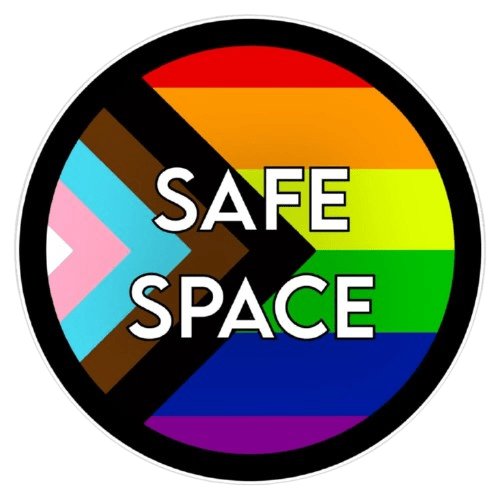
I love the concept of the Safe Space. I have buttons and pins that have the words “Safe Space” superimposed on the Progress Pride flag. I put them on my backpack that goes everywhere with me. I have small signs with the same image that I put up at my events. I am getting one for my car.You may have seen them as well. But what do they mean? Safe Spaces are created to be welcoming areas for people who are often marginalized or targeted because they are perceived as being “other”. They are environments where people can be accepted without criticism, discrimination or judgement. These spaces are secure and supportive, allowing for authentic expression of gender identity and sexual orientation. These spaces offer active listening, confidentiality and inclusive language. There are many items available with the Safe Space logo and I love them. The Progress Pride flag and the words SAFE SPACE will perfectly illustrate who is welcome and it is perfect. For the record:
- I and my events are a Safe Space for the Gay and Lesbian communities, as I happen to be gay myself.
- I and my events are a Safe Space for the Bisexual community. I have many bisexual friends whom I love, and some of the hottest guys I know happen to be bisexual.
- I and my events are a Safe Space for the Trans community. I have many friends who are trans, and I love them dearly.
- I and my events are a Safe Space for those questioning their sexuality, whom I support without criticism or judgment.
- I and my events are a Safe Space for the Intersex community. You have my utmost respect.
- I and my events are a Safe Space for the Asexual community.
- I and my events are a Safe Space for the Black, Indigenous and People of Color communities. Over the years I have had friends and lovers of all races and backgrounds. You are safe with me.
- I and my events are a Safe Space for the Drag community. You have my highest admiration and respect.
- I and my events are a Safe Space for the BDSM, Fetish and Kink communities. I have quite a few myself.
- I and my events are a Safe Space for the Goth and Vampire communities, who are often misunderstood.
- I and my events are a Safe Space for the Druid, Pagan and Witch communities, as I happen to be all three.
- I and my events are a Safe Space for those in the Adult Entertainment community. as some of my friends over the years have been porn actors and strippers. I happen to watch lots of gay porn myself.
I have also seen Safe Space items that add “for everyone‘. Everyone? That’s not possible. You cannot be a safe space for everyone. There are reasons why these are called Safe Spaces and there are reasons why certain communities are in them. Protection and Safety. Allowing “everyone” into your Safe Space will make it less so, Dangerous, even. For these environments to remain SAFE, we must exclude those who would make it less so. It is important to clarify who is welcome in our safe spaces and who is not. You cannot be a ‘safe space’ for people who are actively trying to erase your existence. You cannot be a ‘safe space’ for people who want to take away your rights. For example:
- I am NOT a safe space for bigots and homophobes, though I’m pretty sure most of you are still in the closet.
- I am NOT a safe space for nazis, racists and white supremacists. You deserve to be publicly shamed.
- I am NOT a safe space for anyone who supports the Trump regime. Don’t buy my books and don’t come to me for readings.
- I am NOT a safe space for evangelical Christians and Christian Nationalists. I have ZERO interest in your Bible and your beliefs.
Safe Spaces are not for “for everyone”, so don’t display signs or pins with those words. The signs that say “for everyone” are inaccurate.
Instead, use this one. It is all you need. There are rectangular versions as well.



 Rick S. Potter