More Than a Dream

I’ve had them since I was a child, these dreams that were more than just dreams. They were never like regular dreams, when the brain is just filtering out the sights and sounds of daily waking life. These dreams are different.

They feel like more than just dreams. They feel like actual events taking place on some other plane of existence. When I have dreams of this nature, they have a beginning, a middle, and an end, after which I abruptly wake up. I am usually given a task, sometimes with other people, and the story completely plays out until the end when the task is completed and I wake up. These are not just dreams. I wake up feeling as though I have been somewhere, and with a strong sense of accomplishment. I don’t have them frequently, maybe once every three months or longer. But I’ve always had them since I was young. I still remember most of them. One of them involved two children and an approaching storm. It showed me what would happen if I challenged the storm (rescue the children), and what would happen if I did not (destruction). The dream played twice with different results at the end. And then I woke up.

More recently, I had another of these unusual dreams. I was in a house with two other people. We were on an upper floor, and there was a coffin in the room. There was an old man in the coffin, presumably dead, and we had been tasked to awaken him. The other two people with me, a guy and girl, both seemed rather accustomed to this sort of thing, but looked to me for guidance. I don’t remember how we awakened him, (I vaguely remember someone mentioning a spell), but soon he was sitting up, eyes open. We helped him out of the coffin and into a chair. He was rather shaken by the fact that he was dead. He was more talkative and calm when we held his hand. Our touch seemed to give life to him. When we let go of his hand, his eyes would close and he would slump in his chair. There was a pen and notepad nearby, on which I wrote down everything he said. As I held his hand, he wept a few times and thanked us for what we were doing. He told me about his sister, Anna, who “loved lavender so”. He told me about his daughter, who prepared the flowers for his funeral. He told me about his son who makes “beautiful wood furniture”. There was a long wooden staff in his coffin, which had been laid next to him. He spoke only of his family and very little about himself, except that he had died suddenly, before he had time to realize what was happening. We knew it was important to keep holding his hand until he was finished. He looked at the three of us and said, “I have been awakened by Love”. He was referring to us. We all had strong feelings of compassion for the old man and he could sense it. He then looked up and made an appeal to the divine, “Give me strength. Give me courage. Give me life”. He then slumped in his chair. He had shared with us his love for his family and made peace with himself. We gently placed him back in his coffin.

After this, a few ‘maybe related’ things happened. I had a motorcycle, which for some reason was also on the second floor of the house with us. It was having some issues and I had planned to take it to a mechanic. I have never owned or driven a motorcycle and never wanted one. I never think about motorcycles, ever, so this was an odd part of the dream. Related somehow, perhaps. The two people with me were people I’ve never met in my waking life. It was clear, however, that they were not put off by waking up the dead. It seemed like a common occurrence for them. The male friend was about to leave when I asked him to help me bring the motorcycle down the stairs. He agreed, and then we were outside. He suggested that I walk the bike to the garage (there was one nearby) instead of having it towed, as that would save money. I agreed to this, my two friends went on their way, and I woke up.

I’m not sure what sort of dream this could be called. It wasn’t shamanic, at least not what people say shamanic dreams are supposed to be like. It wasn’t a prophetic dream, as it didn’t seem to be about the future or involve any kind of divination. We were just there to help an old man accept his physical death, and we accomplished that.

I’m sure there are others who have dreams of this nature, though I would highly doubt those who say they have them every night. Mine are very infrequent, with several months between them. And, they are always as real and vivid as this laptop I’m typing on.

Celebrating the Winter Solstice

The Winter Solstice occurs when half of the Earth is tilted farthest away from the Sun. The pagan celebration at this time (known in some magical traditions as ‘Yule’) goes back to as early as the 4th century. The Germanic-Saxons called it Jol, and the Scandinavians called it Jul. Both translate to the English word Yule. Ancient people were hunters and spent most of their time outdoors. The seasons and weather played a very important part in their lives. Because of this many ancient people had a great reverence for the sun. Midwinter was celebrated with bonfires, ale and storytelling.

The ancient Romans also held a festival to celebrate the rebirth of the year. Saturnalia ran for seven days from the 17th of December. It was a time when the ordinary rules were turned upside down. Men dressed as women and masters dressed as servants. The festival also involved decorating houses with greenery, lighting candles, holding processions and giving presents.

The Winter Solstice falls on the shortest day of the year (around 21st December) and was celebrated in Britain long before the arrival of Christianity. The Druids would cut the mistletoe that grew on the oak tree and give it as a blessing. Oaks were seen as sacred and the winter fruit of the mistletoe was a symbol of life in the dark winter months. It is believed that it was also the Norse who began the tradition of the Yule Log, although they likely did not refer to it as such. The earliest recorded mention of a ‘yule log’ was in the year 1686. The log was lit to conquer the darkness, banish evil spirits and bring luck for the coming year. Many of these customs are still followed today. They have been incorporated into the Christian and secular celebrations of Christmas. According to some traditions, it must come from one’s own land or be a gift, and it must not be purchased. It is traditionally ignited with the remaining piece of last year’s Yule log. This way, the light is passed on from one year to another. The Yule log is to burn slowly for 12 days in the fireplace, before it is extinguished. The ashes are stowed away and in springtime mixed with seeds and brought out on the fields. In this way the power of the Sun, symbolized in the Yule log, is distributed over the land. The rest of the wood is kept until next year to ignite the new log.

In this darkest time of the year we celebrate the return of the Sun, who will bring warmth, light and life back to the Earth. In the Druid tradition the name of this holiday is “Alban Arthan”, Welsh for “Light of Winter”. According to an older and more poetic interpretation, the name is “Alban Arthuan”, meaning “Light of Arthur”. In this poetical image, Arthur is symbolized by the Sun. The Sun dies and is reborn, just as the mythical Arthur is sleeping deep inside a mountain and will wake up again when the people needs his help. Alban Arthan, the Winter Solstice, takes place every year on the 21st or 22nd of December. We know today that the Sun will return, because the course of the Sun and the other planets in our system have been scientifically explored. Our ancestors did not take the return of the Sun for granted, and in addition they were suffering much more under the hardships of severe winter weather than we do today. For an agricultural society, whose survival depended mostly on crops, the return of the Sun was not just a matter of celebration, it was rather a matter of life or death.

In the Blackthorn Order, it is not only the sun that is acknowledged, but also the longest night of the year. We take advantage of these dark hours to examine our own darkness, exploring areas of our lives that need more light. We must also recognize the darkness of the world, and send light to those places on our planet that are struggling the most due to war, famine and disease.

At this time of year, the house is decorated with evergreen branches. Plants that remained green all year were symbols of fertility and the continuance of life. In the Irish tradition, a house decorated with greenery is expected to offer a place of rest to nature spirits fleeing from cold and darkness. The plants of the season are mistletoe and holly, as well as all evergreen plants, such as spruce, fir, and pine.

Every Winter Solstice, I do a private ceremony at home. This always includes a tarot reading to get insight into the coming year. On the Winter Solstice of 2022, I used seven cards. I found that seven cards provided far too many references to pinpoint specific events and times. This year, 2023, I will use only four cards, one for each season. I think four cards will help to nail down potential events to those four three-month periods. When doing this kind of reading, it is important to understand that what you see in the cards may not always apply to your personal life, but also to events happening in the world, events that may directly affect you.

As you celebrate the Winter Solstice, may you learn from the darkness as you await the return of the light.

Beeswax Candles And Witchcraft

Candles are necessary tools for the witch, and they are not to be chosen arbitrarily. The type of candle is important, as well as any colors, scents or additives used. For a long time, I used paraffin candles. They are inexpensive, hold scent well and are fairly easy to make. They are very popular with many witches and pagans who use them when casting spells and or any kind of ritual work. You can get them in a multitude of colors, shapes and sizes. Many consider parrafin candles to be ideal. But are they really? For certain purposes, perhaps. Scented candles can make your house smell good, and they create a nice ambience when you have company. They’re aesthetically pleasing, to say the least.

Would I use paraffin candles for magical purposes? Definately not. In fact, it’s probably best not to use them at all. Parrafin candles are made from petroleum by-products, and release numerous chemicals and toxins into the air when burned. More of these harmful substances are released if synthetic fragrances and artificial dyes have been added to the candle. Paraffin also emits many carcinogens. In fact, the toxins released from paraffin candles are the same as those found in diesel fuel fumes and are linked to asthma and lung cancer. The environmental impact of paraffin should also be noted. Crude oil, being the origin of paraffin wax, is considered highly unsustainable, being a non-renewable resource.

What about soy wax? Many witches choose candles with this type of wax, made from soybeans, as a more natural alternative to parrafin. However, soy wax will spoil without preservatives and often contains chemical additives, hardeners and bleach. If you look at a soy candle that has been sitting on a shelf for a long time, you will see how it is beginning to break down.

Several years ago, I decided to use beeswax candles exclusively, for a number of reasons. Beeswax is 100% natural. When burned, beeswax produces negative ions which bind with air pollutants, thereby cleaning the air. Beeswax is completely biodegradeable and compostible. Beeswax candles burn brighter and longer than paraffin and soy candles. They emit very little soot or black smoke. Votives and pillars made from beeswax drip very little, however, I have noticed that the taper candles do tend to drip. Be careful if using fancy or expensive candleholders with beeswax tapers, because when they drip down it can be difficult to clean up.

If you make your own beeswax candles, as I often do, there are things you can add to them for spellwork. Pure essential oils can be added to the wax, just remember that beeswax doesn’t often hold scent well, so add a little more than you would for parrafin or soy candles. Make sure you are using 100% pure essential oils and not a chemical candle fragrance. The idea is to use only natural materials in your candle. You can also add a pinch or two of dried plants, according to your magical purpose for the candle. You can either add it to the wax or sprinkle a little on top of the candle while it is still warm and cooling. You only need a little. If you add too much, the wick could ignite it and your candle will burn too quickly. Some like to roll it in dried herbs that stick to the outside of the candle, and these are quite lovely and Old World. You may also choose to carve magical symbols on the side of the candle. Another practice is to dress the candle with oil, using a specially chosen pure essential oil. Traditionally this done from the middle upwards, and then from the middle downwards.

Some people like to add colors to their beeswax candles. My view is that this introduces an unnatural material to the candle and is not really necessary. A possible exception would be to use natural dyes, which is something I’ve never tried with beeswax. My belief is that beeswax is already so pure and natural that adding a chemical or some unnatural substance will make it less effective for spellwork and magical ritual.

You can program a beeswax candle with a magical charge using the following simple method.

  • Hold the candle in both hands.
  • Close your eyes and take several deep breaths until you reach a meditative state.
  • In your mind’s eye, visualize the candle bathed in a brilliant white light.
  • Say three times: “I charge this candle to be an instrument of (healing, protection, peace, etc) for the highest good, with harm to none”.
  • Light the candle and let the magic begin.

Beeswax candles hold a magical charge quite well, and are strong conduits for magical energy. They help us tap into the magic of the Old Ways, when witches of ancient times used them in their spells and enchantments. For witchcraft, beeswax is the perfect choice.

Power of the Witch’s Circle

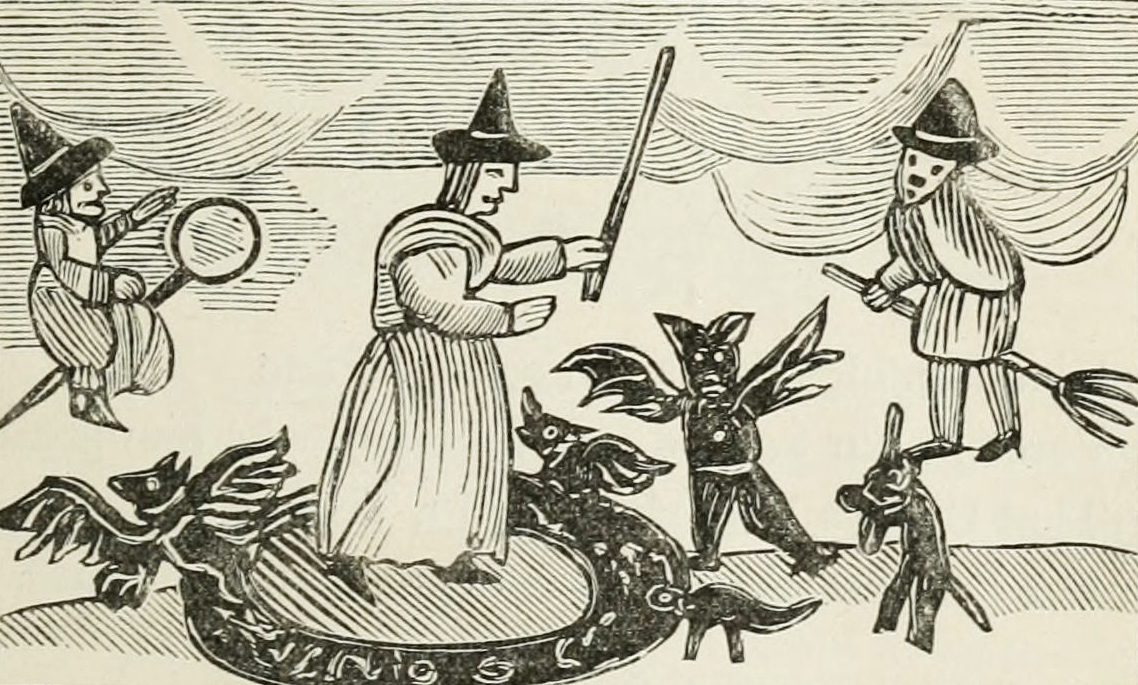
Witches do much of their work in what is called the “magic circle” or “witch’s circle”. This is where spells are cast, rituals are performed, magical tools are consecrated, and meditation and other introspective techniques can all be practiced. By casting the circle, we are creating sacred space, a “world between worlds”. It is a space that not only contains and amplifies the energy we raise within it, it also serves as a barrier to deflect any energies that may be harmful. It is a place where the creative forces of the Universe gather with us to make magic. The circle is a microcosm of the Universe, and perfectly illustrates the concept “As Above, So Below”. Whatever is created in the circle (Below) will eventually manifest in the astral (Above). Circle-casting is not a product of modern Wicca, as some claim. The earliest known record of a witch’s circle comes from a woodcut illustration in 1608, depicting witches gathered in a circle traced upon the ground. Early Puritans demonized this concept by placing the Devil outside the circle, to imply that the witches had conjured it. There are also medieval woodcuts of witches dancing in a circle. The circle has been used by witches for centuries, long before Gerald Gardner (the “father” of modern Wicca) was born.

Casting the circle is not to be performed haphazardly or with a casual attitude. Do not just say the words and go through the motions. Do not rush the words, take your time and pay attention to what you are saying. Circle-casting is an art that requires strong focus, visualization and intent. When the circle is complete, it is no longer a circle, but a sphere. This is so that not only the circumference is protected, but also the areas above and below the sacred space you have created. Before casting the circle, however, it is important to be in a right state of mind. The circle intensifies whatever energy is brought into it. If you are angry or tense, you are going to bring that energy unless you do some centering and grounding exercises first. Before beginning any ritual, the first step is meditation. Simply close your eyes, take some deep breaths until you reach a meditative state. Prepare yourself spiritually and mentally for what you are about to do. Put away all worries and concerns of the day. Once you have reached this level of what we call “ritual consciousness”, then you may begin casting the circle. Many people skip this step, and it has detrimental effects on the energy of their circles. Another important thing to do before casting your circle is to cleanse the area. This can be done with incense, salt water, a lit candle, or through white light visualization.

The method below is not the only way to cast a circle, but it is a traditional method.

  • Cleanse the area with incense, salt water or visualization.
  • Close your eyes, put away all worries of the day, and take several deep breaths until you reach a meditative state of mind.
  • Stand up and face the North or the East (whichever direction feels right for you). Using both hands, grasp a sword, athame (a black-handled ritual blade) or wand, and point it upwards. Not vertically straight up, but in an upwards diagonal position. If you don’t have these tools, it is perfectly acceptable to use the forefinger of your dominant hand.
  • Begin walking clockwise in a circle, and visualize a blue flame coming out the end of your sword/athame/wand. You will walk this circle three times while making the following three statements, one statement for each circle. If your space is limited and you can’t walk around, you can stand in one spot and pivot as you cast your circle.

CIRCLE ONE: I cast this circle to protect me from all harmful energies.

CIRCLE TWO: I cast this circle to allow only the most perfect energies for this work.

CIRCLE THREE: I cast this circle to be a sacred space for the highest good, harming none.

  • Do not just say the words, but think about what you’re saying. “See” it and “feel” it happening. Once your circle is created, it is not uncommon to sense a difference in energy and temperature. As you walk the circle three times, visualize the blue flame forming a circle in the air around you. You can write your own words for circle-casting, and make them as creative and elaborate or as simple as you want, but they must include the intentions that your circle is for protection from harmful energies and is a sacred space.
  • Next, point your sword/athame/wand straight up and say “As Above”. Visualize the top half of the sphere being formed by the protective blue light. Then point your sword/athame/wand down so that the tip is touching the ground, and say “So Below”. Visualize the bottom half of the sphere being formed. You have now created not only a circle, but a sphere of protection.

It is important to visualize the entire process of circle-casting as clearly as you can in your mind’s eye, with strong focus and intention. You are not just saying words. You are creating an energetic sphere of protection and power.

At this point, many witches invite the elements of Earth, Air, Fire and Water into the circle by facing their associated directions. This is also done in a clockwise direction: North/Earth, East/Air, South/Fire, West/Water. You may also invite any deities or spirit guides to assist and lend their energies to the circle. Now you are ready to do magic or anything else you have cast your circle for.

Releasing the Circle

  • At the end of your ritual or magical working, if you have invited the elements, thank them for their assistance, and gently release each one in a counter-clockwise direction with a statement like “Stay if you will, but go if you must”. Remember to thank your deities and spirit guides for lending their energies to the circle.
  • Return to the same position where you began your circle (North or East), and point your sword/athame/wand upwards again. While walking a counter-clockwise circle only once, say “This circle is released”. As you walk the circle, visualize the blue flame of the circle/sphere dissolving into nothingness. When releasing the circle, it is only necessary to walk the circle one time.

You can cast the witch’s circle for any purpose you choose. Meditation, divination, communing with deities and spirit guides, spells, to celebrate the Sabbats or the Full Moon and New Moon. The circle creates an energetic boundary where the only forces programmed to be there are for your highest good.

Divining with the Pendulum

Most people prefer to use a pendulum with the same hand they write with. Personally, I don’t think it really matters which hand you use. I happen to be left-handed, but my own pendulum seems to work better when I use it with my right hand. You may wish to practice with both hands and see which works better for you. If you are sitting down, rest your elbow on a table and hold the chain of your pendulum between your thumb and first finger. The palm of your hand should be facing downward, and the pendulum should be hanging about a foot in front of you. If you are standing, the best position is to have an angle of 90 degrees at the elbow, so that your forearm is parallel to the ground.

Getting Started

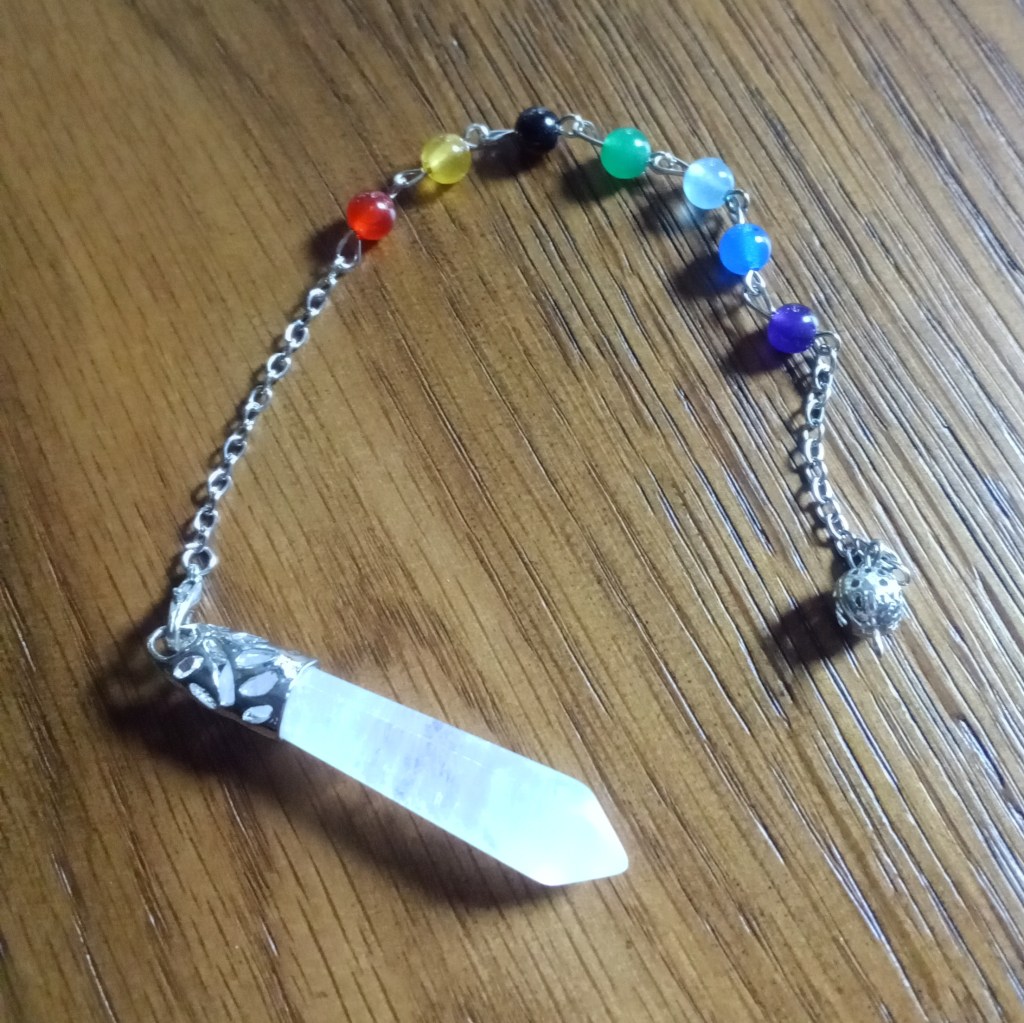
Hold the pendulum in front of you and allow it to swing in a clockwise motion. Then swing the pendulum gently back and forth to become familiar with the movement. Allow the pendulum to swing in different directions. Deliberately swing the pendulum in gentle circles. When the pendulum is still, ask it which movement indicates a “Yes” or ‘positive’ response. It may take time for the pendulum to move. Be patient. Then ask it to indicate a “No” or ‘negative’ response. Many people use the pendulum to help locate lost objects, determine a best course of action or to answer “yes or no” questions. There are helpful pendulum charts, cloths and boards, but these are not necessary for the pendulum to work. Preferred pendulums are made of wood or from crystals and stones. Some believe pendulums made of conductor materials like silver, copper or brass should not be used. Those made of quartz crystal seem to be most effective, as this stone is easily “programmed” with intention and stores magical energy quite well. My own pendulum is made of a quartz that seems to glow in the light, and I am always astounded by it’s accuracy. When you find a pendulum you like, it is important that you do not treat it as a trivial object. Regard it as a sacred, divine tool. When not using it, keep it in a pouch made of natural fiber, and do not allow anyone else to touch or use it. Your pendulum will attune to your energy, so you must keep it safe and away from the hands of others.

How It Works

The unconscious, involuntary movements of the hand holding the pendulum cause it to move. The subconscious mind of the person holding the pendulum causes the muscles to react unconsciously. The pendulum amplifies responses that would otherwise be too small to notice. Consequently, the answers are coming from your connection to the Divine Mind. The pendulum gives us access to our subconscious minds. The subconscious mind accesses the Divine Mind that contains all knowledge. The pendulum accesses our subconscious minds, which in turn taps into the Divine Mind, and the pendulum gives us the answer we seek. When using the pendulum, it is best to be in a meditative Alpha state. This will make it easier to access the subconscious. Watch for the gentle “pull” of the pendulum guiding you to the answer you seek.

Practice

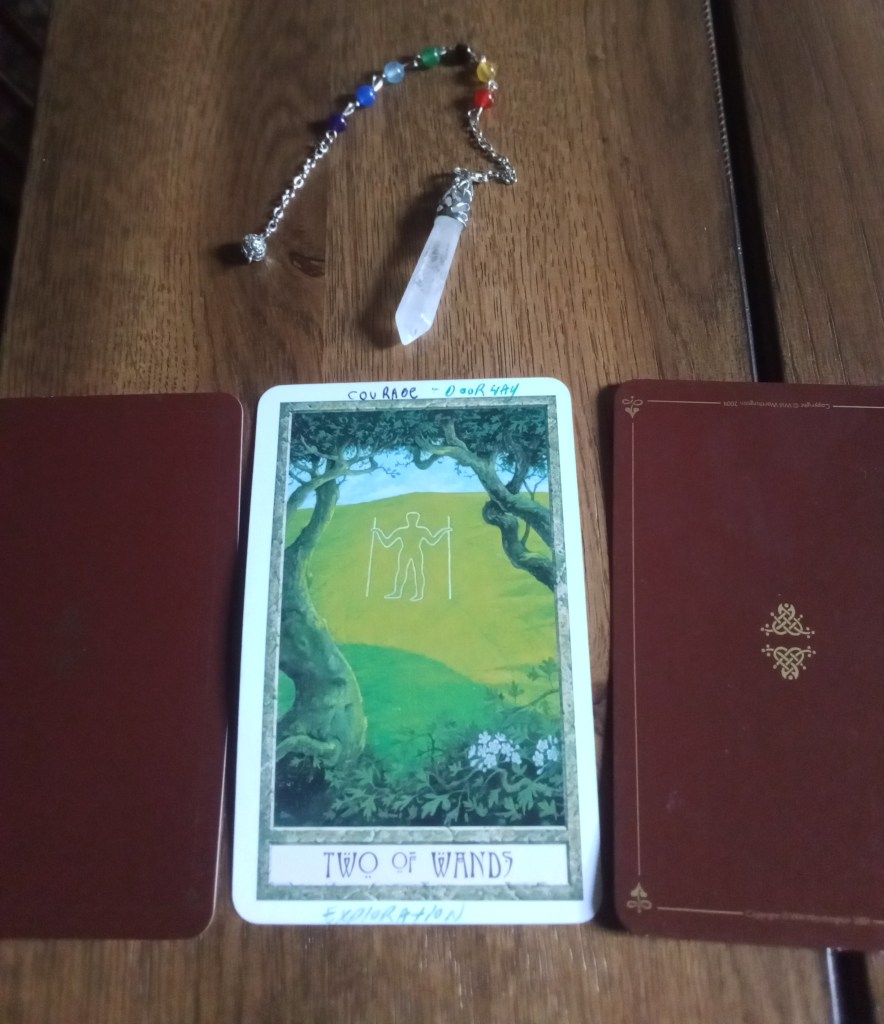
One of the best ways to develop your skills with the pendulum is with the use of tarot cards. Choose five random cards from any tarot deck. Look at them to see what they are and write them down. Turn all five cards face down, and then close your eyes and shuffle them so that you don’t know which card is which. Place them all face down in front of you. You will be asking the pendulum to locate each specific card, one at a time. Let’s say you know that one of the five cards is the Two of Wands. Hover the pendulum a few inches above each card and ask “Is this card the Two of Wands?

This is where it gets tricky. It is important to take your time and not to rush this process. Patience is necessary here. It took me awhile to realize what was happening, and I was pleasantly shocked when I first saw it.

Hover your pendulum still (in other words, don’t move it in circles or anything like that), over each card for about 10 to 20 seconds. Keep your focus on the card you’re looking for, in this case, the Two of Wands. Watch the pendulum very closely for subtle movements. There will be no movement at all, or very little movement over the incorrect cards. As you approach the correct card, the pendulum may start to vibrate or move in small circles. It sometimes does this over the incorrect cards as well, but movements over the correct card will be more defined. Continue hovering the pendulum a few inches above each card while observing any movement. The pendulum needs to “read” each card before it can choose the one you’re looking for. Go from left to right, then right to left, and continue this until you begin to see a pattern. As you move from one card to the next, you will eventually begin to see the pendulum being pulled slightly to the left or the right. It will appear as if an invisible finger is gently directing it toward the correct card. This is exactly how it looks to me. The first time I did this experiment, the pendulum correctly identified all five cards. Since then, my pendulum has become one of my most powerful divinatory tools.

Healing with the Pendulum

Ask the person seeking healing to lie down, then hold the pendulum about 1 foot above the body, starting at the head. Scan the entire body from head to feet, while watching the movements of the pendulum for any irregularities. Ask the pendulum to indicate areas that need healing. There will be a slight pull of the pendulum toward unhealthy areas. Place the hand not holding the pendulum over these areas and visualize white light coming out of your hand and into the person’s body.

To send healing to someone who is not present, you will need a pendulum and two beeswax candles placed side by side about a foot apart. The candle on the left represents you, the candle on the right represents the person you wish to send healing to. Bring yourself into a meditative alpha state and visualize the other person as clearly as you can in your mind’s eye. Swing the pendulum back and forth slowly from one candle to the other in a continuous motion. Visualize healing being carried from the candle on the left (You) to the candle on the right (the other person). Do this until you intuitively feel the process is complete. Then, stop the swinging of the pendulum with the other hand. Blow out the left candle, then the right. Picture the other person fully restored to health.

Divination

The word ‘divination’ is derived from the word ‘divine’. This indicates that the practice of divination is empowered by a divine source. When we practice any form of divination, we are essentially calling on the divine to assist us through the chosen medium (such as a pendulum, crystal ball or tarot deck). In this light, it is not far-fetched that the pendulum is being guided by an unseen force.

Celebrating Lughnasadh

Of all the Celtic Gods, Lugh was one of the most beloved. He was the “Shining One”, according to some versions, a son of Mannanan MacLir, and skilled in all the arts. He was called Lugh Lamfada (“of the long arm”) and Samildanach (meaning “skilled in all the arts”). He was a beautiful child with golden hair like the sun. He is portrayed as handsome and youthful. Tailtiu was the Goddess of Sovereignty, the queen of the Fir Bolg and his foster mother. She lived on the Hill of Tara, where she taught Lugh, helping him to learn about history, poetry, music and everything he would need to learn to be a well-rounded and powerful leader. When Lugh became an adult, he tried to enter the court of King Nuada (NOOa-ha). Just as everyone was sitting down to feast. The gatekeeper challenged Lugh to tell his name and of his skill. For no one without a special art or skill may enter Tara.
“I am a smith”, said Lugh.
“We already have a smith”, said the gatekeeper. “Why would we need another?”
“I am a warrior”, said Lugh.
“We have no need of one”, laughed the gatekeeper, “Ogma is our champion”.
“I am a harpist”, said Lugh.
“We have a harpist”, said the gatekeeper, “and quite a good one at that”.
“I am a hero” said Lugh, “renowned for skillfulness rather than mere strength”.
“All of the gods are heroes”, the porter shook his head at Lughs persistence.
“I am a poet and a tale-teller from the land of apples, rich in swans & yew trees” said Lugh.
“Taliesin is the greatest poet in Ireland”, said the gatekeeper, “Why would we need you?”
“I am a cup-bearer”, said Lugh. “We already have nine of them”, said the porter.
“I am a worker in bronze”, said Lugh.

“We have no need of you. We already have a worker in bronze”, said the gatekeeper.
“I am an historian, a doctor, and a magician”, Lugh told him.
The gatekeeper responded, “We already have men skilled in all these things. I dont see why we would need your services”.
“But do you have anyone who is master of all of these crafts at once?” Lugh asked.
The gatekeeper had to admit that they did not, and invited him in. Lugh entered and sat down upon a chair kept for the wisest man. The champion, Ogma was showing off his strength by pushing around a large flagstone. The stone, as huge as it was, was only a portion broken from a still greater rock. Lugh picked it up in his hands and put it back in its place. The king asked him to play the harp. Lugh played the sleep-tune and the king and all his court fell asleep until the same time the next day. Next Lugh played a lamenting tune and they all wept, and then he played a song which brought them joy. When the king saw all these talents he gave the throne to Lugh for thirteen days. Lugh became the leader of the Tuatha De Danann.
Lugh’s foster mother Tailtiu died of exhaustion after working hard to clear the lands of Ireland for farming. Lugh was so fond of her that he held a festival in her memory. People would gather around bonfires, sharing stories and food. They would compete in contests of skill and strength. Lugh invented ball games and horse races for all to play. It was said that as long as these traditions continued there would be corn and milk in every house, peace and fine weather for the feast. Tailtiu became the Goddess of the Harvest, like Ceres to the Romans, and Corn Mother to Native Americans. She looked on as her children played and feasted. The festival of Lughnasadh is still celebrated in memory of Lugh the Sun King, and his beloved Foster Mother and Teacher; Tailtiu.

Lughnasadh (Festival of Lugh) is the first of three harvest festivals, traditionally celebrated on August 1st. In Irish Gaelic, and a slightly different spelling, Lunasa is the word for August. In the Christianized version, it is called Lammas (meaning Loaf-Mass or the Feast of Bread, at which time the first loaves of the season were blessed by the church). The hot days of August are now upon us, much of the earth is dry and parched, but we still know that the bright reds and yellows of the harvest season are just around the corner. Apples are beginning to ripen in the trees, our summer vegetables have been picked, corn is tall and green, waiting for us to come gather the bounty of the crop fields. Now is the time to begin enjoying the fruits of our labors, both on the table and in our lives. We honor this holiday to celebrate the first harvest, and the Celtic God Lugh, the sacrificed King of the Grain. Grain has held a place of importance in civilization back nearly to the beginning of time. Grain became associated with the cycle of death and rebirth. In early Ireland, it was a bad idea to harvest your grain any time before Lughnasadh — it meant that the previous year’s harvest had run out early, and that was a serious failing in agricultural communities. However, on August 1, the first sheafs of grain were cut by the farmer, and by nightfall his wife had made the first loaves of bread of the season.

Lughnasadh is a day of honoring Lugh, the Celtic craftsman god. He is a god of many skills, and was honored in various aspects by societies both in the British Isles and in Europe. Lughnasadh is still celebrated in many parts of the world today, and his influence appears in the names of several European towns. In our modern world, it’s often easy to forget the trials and tribulations our ancestors had to endure. For us, if we need a loaf of bread, we simply drive over to the local grocery store and buy a few bags of prepackaged bread. If we run out, it’s no big deal, we just go and get more. When our ancestors lived, hundreds and thousands of years ago, the harvesting and processing of grain was crucial. We honor our ancestors and the hard work they had to do in order to survive. This is a good time to give thanks for the abundance we have in our lives, and to be grateful for the food on our tables. As we enjoy nature’s abundance, what can we give in return? Lughnasadh is a time of transformation, of rebirth and new beginnings. Because of its association with Lugh, The Many-Skilled One, Lughnasadh is also a time to celebrate talents, skills and craftsmanship. What are your talents and gifts? How can you share those talents and gifts with others? Now is the time of year to work on developing your own talents. Learn a new craft, or get better at an old one. Start a creative project, write a book, play a musical instrument, sing a song, dance, paint. Learn a new magical skill, such as the reading of runes or the making of candles. Whatever you choose to do, this is the right season for thankfulness and sharing.

Re-Awakening The Witch

The practice of witchcraft has undergone many changes throughout the years. Some of these changes have been good and some of them not so good. Some changes are being touted as “modern ideas”, while older practices are regarded as “outdated” or “no longer relevant”. The ways of the Witch have become sanitized and diluted to make them more acceptable to the masses. Witches are not feared as they once were. The witch is more than just someone who wears pretty crystals and lights scented candles, while chanting healing words under a full moon, with New Age music playing in the background. There is a place for this, but we must not become too attached to a romanticized image. A witch can make someone’s life easier. A witch can also make someone’s life very unpleasant, and sometimes it is necessary. We are not docile and harmless. For the witch, Light and Dark are two sides of the same coin. In the old days, you wanted to be on the witch’s good side. To provoke a witch could be quite dangerous. For a very long time, witches were respected and feared in equal measure. Then along came the Wiccan Rede. The disclaimer “Do what you will and harm none” made it socially acceptable to be a witch, as in “I’m a witch but it’s okay because I follow the Rede”. This generated the false notion that “good” witches follow the Rede and “bad” ones do not. Before Gerald Gardner and Doreen Valiente, there was no Wiccan Rede, no Threefold Law. Witches were simply witches, living by their own ethical codes and moral standards. They were sovereign, each living according to their own rules. This is the way of the Old Ways Witch. It is not because of the Rede that the innocent are not harmed. The reason the innocent are not harmed is because they are innocent. The other side of this coin is that those who provoke a witch can no longer claim innocence. Back us into a corner and we come out fighting. If someone has a knife to your throat, throwing “love and light” at them isn’t going to save you. You will do what is necessary to protect yourself. There are times when banishings, bindings and curses are absolutely called for, such as when dealing with a stalker or someone seeking to harm your family. There are also times when they are definately NOT called for, such as when an insecure High Priestess chooses to banish from the community anyone who disagrees with her. I do not completely agree with the idea of doing something to make their lives better so they leave you alone. It’s a bit like that ridiculous Bible verse that says “bless those who persecute you”. Sure. Bless them so they can persecute others. Sorry, NO. The witch must remain someone who is both respected and feared.

The Witch and Sovereignty

As a witch, it is your right be sovereign. You develop your own practices, rituals and spells, using methods that work best for you. The way you practice witchcraft is not subject to anyone’s approval or permission. There are far too many people on social media trying to police how others practice. It is childish and ridiculous. I have seen both extremes. There are those who say you’re not “authorized” to engage in certain magical practices unless you belong to a particular culture or tradition. There are casual, lazy types who spout such nonsense as “you don’t need anything, you have all you need within you” and “the only important thing is intention”. They make witchcraft seem so simple, so easy, as if you could cast spells while you’re eating a cheeseburger or watching a movie and you don’t even have to get up from the couch. Witchcraft is not as simplified as people try to make it seem.

The Witch and The Night

The most powerful witches make a connection with the energies of the night. When the moon rises, and many begin preparing for sleep, this is when the abilities of the witch are strongest. It is during the night-time hours, particularly between 3am-5am, when astral interference is at it’s lowest ebb. The chaotic energies generated by social interactions, cellphones, traffic and other anxieties of the day have ceased, if only for a short time. During this time the spells cast by a witch can flow unhindered through the ether. The powers of psychic suggestion and magical intention reach their destinations with less impedance. The night has a special kinship with the word occult, which simply means hidden. In the same way that the night hides and obscures, occult wisdom is hidden from those without the awareness to comprehend it. Witches are the hidden ones. They do not fear the night, for they wear it as a cloak. Witches have long been associated with the night, as they themselves are creatures of the night.

The night is a conscious force with it’s own tangible energy. The darkness of Night is the realm of potentiality, the nothingness from which all things emerge. All things are birthed out of darkness, from the plants that rise from beneath the earth to the child that emerges from the darkness of the womb. To tap into this force, simply wait until the midnight hour has passed and turn off all lights. The only light should come from natural sources, such as moonlight or candlelight. Open a window, close your eyes and take several deep breaths until you reach a meditative state. Isolate that sound of night-time stillness. This can be difficult to do if you live in a metropolitan area, with constant sirens, car horns and people shouting in the street. If this is the case, treat it as an exercise in concentration and focus. If you live in a rural or wooded area, it will be much easier. Tap into the indefinable energy of the night.

When we look up into the night sky and gaze upon the moon goddess in all of her fullness, we can feel a sense of nurturing and maternal love. Old witchcraft lore tells us that the moon has a strong link with the spirits of the dead. Communication with the spirit world can take place with much less restriction during the late night hours. Those who interact with spirit guides and the departed dead find that their communications are much clearer and easier to interpret during the dark of the night. Divination tools such as the tarot and the crystal ball seem to be particularly enhanced in the night-time hours.

The Witch and the Liminal

Many modern witches seem to have forgotten that we are meant to “walk between the worlds” of the seen and the unseen, the living and the dead, the magical and the mundane. A witch of the Old Ways communes with many spirits, not only of the departed dead, but also the spirits of plants, stones, trees, bodies of water, animals and planetary forces. Like the Long Man of Wilmington, we stand in the doorway that separates this world and the Otherworld.

Long Man of Wilmington, East Sussex, England

The Witch and Blood, Bone and Shadow

A truly powerful witch does not shy away from the use of blood (usually their own) in rituals and spells. Our blood contains the essence of our ancestors. Blackthorn Witches place three drops of their own blood into their wands. This infuses the wand with their life force and forges a stronger bond. Blood is a powerful addition to spells. There is nothing evil or malevolent about using blood in witchcraft. It produces quick results and connects us to those who came before us. Many witches also frequently use bones, particularly animal bones and skulls. This helps us connect with animal guides and partake of their wisdom. Many will also use artificial human skulls as a tool to contact the dead, as bones contain ancestral DNA. Working with ‘shadow’ in witchcraft not only refers to the Shadow Self, those things we keep hidden from others, but also to the retrieval of hidden wisdom. The late Raven Grimassi has written some very informative works on this topic. Blood, Bone and Shadow are also linked to three colors of traditional witchcraft: Red, White and Black. You may have seen traditional witches wearing cords made from these colors. Red is linked to Blood, White to Bone and Black to Shadow.

Re-Awakening The Witch

These concepts and ideas are not often seen in the lives of many so-called “modern” witches, those who view witchcraft as a hobby or something fun to do on the weekend. Witchcraft is not all love and light, incense and candles. Those who choose to call themselves “witch” must also embrace the necessary darkness that it holds. It is equally important that others see us not only as someone who can help them, but also someone who is not to be provoked without consequence. The time has come to re-awaken the witch and return to the Old Ways.

The Magic of Moonstone

Moonstone is a natural stone, formed from the mineral feldspar. The inter-growth of different types of feldspar during gem formation are the source of the moonstone’s shimmer, also known as adularescence. The finest moonstones are found mainly in Sri Lanka and Southern India. Moonstone is linked, of course, to the Moon and to the element of Water. It is used to call upon lunar deities, particularly the Moon Goddess of Old Ways Witchcraft. It is useful with all forms of divination. The powers of the Moonstone help to enhance psychic and intuitive abilities, astral projection, lucid dreaming and shamanic journey practices. It can be in blue, white, peach, pink, rainbow or tan colors. Moonstone helps to stabilize emotional states, and helps to release stress and tension. It helps to lessen mood swings and prevent over-reacting to situations and pressures. Magical practitioners believe it’s powers increase as the moon is Waxing to Full. Moonstone is favored by cats, children and those who are traveling. It is believed to help the growth of plants, and increase the flow of beneficial energies during magical ritual. Moonstone has long been known for its calming, soothing qualities on the emotional body. Its energy is balancing and healing, assisting in the mastery of emotions by bringing them under the control of Higher Will, rather than expressing or repressing them. It also helps identify emotional patterns that are stored in the subconscious, and serves as a guardian to contain explosive passions, and to stimulate confidence and composure. It has a mystical quality that helps witches tap into the subconscious and access the hidden realms. I happen to prefer the peach-colored variety, and hold one in each hand while meditating. I will sometimes place a flat moonstone on my forehead while lying down after a stressful day at work. It’s energies are very calming and soothing.

To Cleanse and Purify The Home

Materials:

Incense: Frankincense & Myrrh, Dragon’s Blood, Sandalwood

Rose Water

Drum or Bell

First, open all windows and doors. Close your eyes and take several deep breaths until you reach a meditative state. Light incense containing any combination of the scents listed above, ideally in the form of a bundle that will remain lit for awhile. You may have to blow on the bundle periodically to keep it lit. Start at the back of the home, and walk through each room from corner to corner, filling each room with smoke. As you walk, you may repeat “All harmful energies are now banished from this place”. As you finish with each room, maintain your meditative state, and visualize each room filled with white light. You may wish to raise your right hand and project this light out of your hand into each corner of the room. Cleanse your house in this way, from back to front, pushing all harmful energy out the front door. If you have a 2-story home, begin on the upper level first, then continue with the downstairs. If you have a drum, after you have cleansed each room with smoke, bang the drum loudly 9 times in each room. If you use a bell, ring the bell 3 times in each room after cleansing it with smoke.

You may also wish to add 9 drops of Sage or Dragon’s Blood pure essential oils to mop water and clean the floors. This is known as a “Floor Wash” and some witches use this for additional protection in the home. Finally, take a bottle of Rose Water in a spray bottle, and spray all corners and thresholds of each room.

Return To The Old Ways

The snow is falling again here at our mountain cottage. It is still Winter, after all. I am just now beginning to recover from a nasty bout of the flu. I tested negative for Covid, for which the management at the day job will be thankful. I still have a nagging cough, sore throat and runny nose, but I am not as fatigued or physically exhausted as before. The fact that I can sit here at this laptop and write means I am improving. Elderberry syrup, hot green tea and lots of sleep have been my saving grace. I’ll spend this weekend resting, writing and reading. I started reading the Prince Harry book, Spare, and it is absolutely riveting. Very hard to put down. I have such admiration for those two, choosing to live their lives on their own terms. Diana would be proud. I remember that car crash, when the whole world mourned.

Later this afternoon, I will have to give the dog a bath. He’s been scratching more than usual lately. I’m dreading it because he sheds profusely and I’ll need to clean the tub afterwards. A tough job but someone has to do it.

Because of my illness, my book projects were on hold, but today I may be able to dive back in. The novel is a long-term project, one that I am not going to rush. The short-term project, a book of witchcraft for beginners, is an idea that came to me recently and is what I will spend some time on this weekend. I’ve been thinking a lot about witchcraft and it’s connection to nature, and how so many pagans, particularly younger ones, often do not realize the importance of this connection. There is so much mystery and mysticism tied to witchcraft, and some aspects are not so easily defined or pigeon-holed. Social media has become a chaotic mess of people asserting their ‘adeptness’ or ‘expert knowledge’, each trying to outdo the other and become some kind of rock star in the pagan community. A practice that is largely personal and experiential is being turned into a list of do’s and don’ts, and gatekeeping, and accusations of “cultural appropriation”, and ridiculous demands for references and footnotes and “where are you getting this from”. There are many different kinds of witches, all with varying gifts and abilities, many of which they did not learn in a class or from a book. People seem to have forgotten this. The practice of witchcraft is centuries older than the formal traditions that developed around it. Not everything in witchcraft can be backed up with references and footnotes.

We need to return to the naturalness of it all. The Old Ways. Interpreting the voice of the wind in the trees, or the shapes conjured by incense smoke and the flame of a burning candle. The secrets revealed in tarot cards and images reflected in a crystal ball. The swing of the pendulum and the casting of runes. Nature is the driving force behind witchcraft. It is not how many followers one has or how many books one has sold. Even this website is not for me to put myself on a pedestal, but to share the wisdom that has been shared with me, and offer my services to those who may need them. To be a witch is not just about magic and spells, but also about nature, healing and service.

There are many who seek to dilute the Old Ways with their so-called ‘modern ideas’, putting aside the wisdom of the elders in favor of new concepts and philosophies. Some are even mocking the old knowledge, calling it “outdated” and “no longer relevant”. They do this at their own peril, forgetting that they are where they are because of those who paved the way. Do not disregard the old teachings or cast them aside like rubbish.

I will cling to the Old Ways with all my being and share them with those who will listen.